
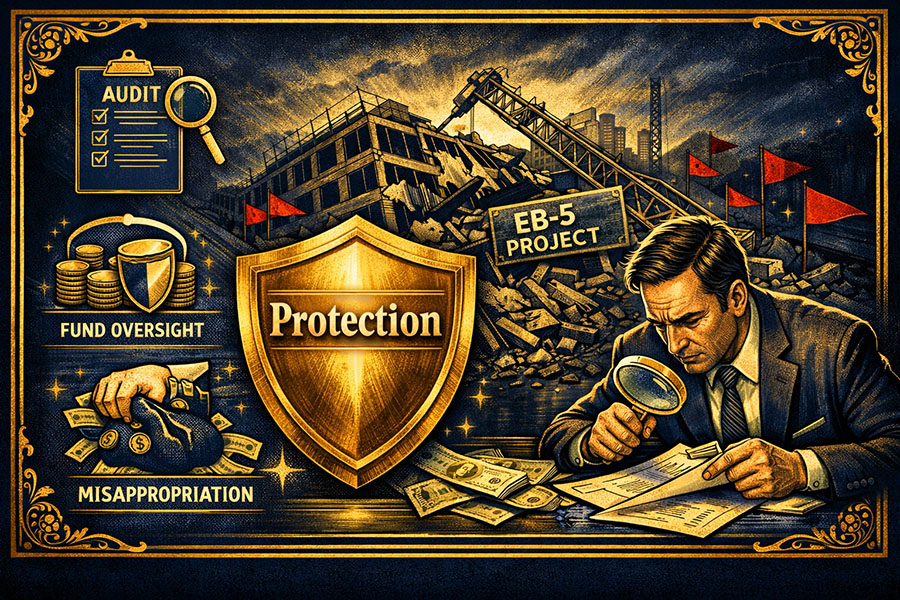
EB-5 projects fail for four repeatable reasons: the developer never raises enough total capital to finish the build, management is incompetent or absent, money is diverted through fraud or self dealing, or the business simply never creates the ten jobs each investor needs. Every one of those outcomes threatens two separate things at once, your $800,000 and your green card, and the two do not fail on the same schedule. Capital can be lost while the immigration case survives, and job creation can fall short while the money is still sitting safely in the project. Working out which failure you are exposed to is the entire point of diligence.
What the Well Known Failures Had in Common
The largest EB-5 enforcement actions on record share a pattern that is obvious in hindsight and was visible at the time. In one Vermont ski resort case, regulators alleged that developers used money raised for newer phases to plug gaps in earlier ones and diverted a substantial share into unrelated uses, including personal spending, while the marketing kept reporting that construction was on schedule. In a Chicago hotel and convention center offering, a promoter raised a very large sum on the strength of credentials and letters that turned out to be fabricated, and regulators froze the money before ground was broken.
The common threads are not exotic. Money from different phases was commingled instead of segregated. Nobody independent was checking whether reported construction progress matched actual progress. The sponsor controlled every entity in the chain, so no counterparty had an incentive to object. And investors accepted marketing summaries in place of audited numbers. Our write ups of notorious EB-5 fraud cases and of what regional center failures teach investors go through the mechanics case by case.
Warning Signs That Appear Before the Money Is Gone
- Any promise of a guaranteed return or guaranteed repayment. EB-5 capital must remain at risk. A sponsor who guarantees principal is either misdescribing the deal or has structured something that will not survive adjudication. Both become your problem, not theirs.
- Deadline pressure. Fraud runs on urgency. Real offerings expect you to take weeks with the private placement memorandum and to have your own counsel read it. If closing the subscription this week is presented as a favor to you, walk away.
- No audited financials and no independent escrow. If you cannot see audited statements for the sponsor, a line item construction budget, and evidence of a segregated account with an independent administrator, you are relying on the sponsor's word alone.
- Ownership chains nobody can draw on one page. Layers of affiliated entities are where self dealing hides. Ask who owns the general partner, who owns the developer, who owns the contractor, and who collects a fee at each layer.
- Job creation numbers that depend on optimistic inputs. Most projects rely on economic models driven by spending and revenue assumptions. Change the construction budget or the occupancy assumption and the job count falls apart. Ask what the model produces if revenue lands twenty percent below plan.
- Resistance to verification. A sponsor unwilling to let you speak to prior investors, visit the site, or read the underlying economic report is telling you something important.
- A capital stack with a hole in it. If the EB-5 raise is the only committed money and senior debt is still described as being arranged, the project does not yet exist.
Two of these deserve extra weight, because they precede the failures that are not fraud at all, just bad execution. The capital stack question and the job model question are covered in depth in our guides to verifying job creation projections and to the wider set of red flags to check before you wire funds.
What the Reform and Integrity Act Actually Changed
The EB-5 Reform and Integrity Act of 2022 rebuilt the oversight regime after the program lapsed, and the changes are substantive rather than cosmetic. It became law as Division BB of the Consolidated Appropriations Act, 2022, and the full text is published at govinfo as Public Law 117-103. The provisions that matter most when you are evaluating a live deal are these.
- Projects are filed and reviewed before investors are taken. A regional center must submit a project application on Form I-956F, the application for approval of an investment in a commercial enterprise, disclosing the business plan, the economic analysis, the fee structure and the securities compliance position. That gives you a document set that has been put in front of the government, not only in front of you.
- Fund administration and segregation. Investor capital must be held in separate accounts, and in most structures an independent fund administrator has to countersign disbursements or the enterprise must submit to annual audits. This is the change aimed most directly at the commingling that sank the earlier cases.
- Audits and site visits. USCIS audits each regional center on a recurring cycle and may inspect project sites to check that what was built matches what was described.
- Background integrity requirements. People with disqualifying criminal or civil fraud history are barred from involvement, and regional centers must certify the bona fides of the individuals connected to them.
- An integrity fund with real sanctions behind it. Regional centers pay an annual fee that funds oversight, and non compliance can lead to civil penalties, suspension, termination and debarment of the individuals involved.
- Protection for investors who did nothing wrong. If a regional center is terminated or debarred, an investor who was not complicit gets a notice period, generally 180 days, to associate with another regional center or otherwise cure the defect without losing the priority date.
Alongside these, USCIS policy now ties the sustainment requirement for investments made under the reformed rules to a two year period beginning when the capital is made available to the job creating entity, rather than stretching it across the whole of conditional residence. The current adjudication standards are published in the EB-5 chapter of the USCIS Policy Manual.
What the Reform Act Does Not Protect You From
This is the part sponsors skip in the webinar. The Act improved disclosure, custody and enforcement. It did not turn EB-5 into a guaranteed product, and nothing in it insures your capital.
An approved I-956F is not a quality rating. USCIS reviews whether a project satisfies immigration requirements, not whether it is a sound investment or whether the developer can execute. Approval of the project, and later of your petition, tells you nothing about whether a hotel will fill its rooms. Separately, most EB-5 offerings are sold under private placement exemptions, so no regulator is vetting the price you pay or the fees being extracted, which is why our page on what exemplar and project approval really mean is worth reading before you treat a government stamp as reassurance.
Enforcement is also mostly retrospective. By the time a case is brought, the money has usually already moved. If you suspect misconduct, the practical channels are the USCIS page for reporting fraud and misconduct and, for criminal conduct, the Department of Justice fraud section. Recovery through either route is slow and usually partial.
If Your Project Is Already in Trouble
Separate the two questions immediately, because the answers diverge. On the immigration side, ask whether the required jobs have already been created or are still in the process of being created, whether the sustainment period was satisfied, and whether the failure was your doing or the sponsor's. Investors frequently preserve the immigration outcome from a project that lost money, provided the jobs were created and the capital was genuinely deployed. On the money side, ask who controls the remaining funds, whether a receiver has been appointed, and what rights you actually hold under the operating agreement you signed. Those rights are usually thinner than investors remember them being.
Then decide whether to stay or move. Investors who reinvested after a failure describe that calculation in our accounts of one investor's project failure and of a second chance after a failed EB-5 investment. Both are worth reading before you assume the case is finished.
Related reading
Sources
This page is written from primary sources published by the United States government. Last updated August 5, 2026. It is general information about how the EB-5 programme works, not legal advice about your case.
- Public Law 117-103, the EB-5 Reform and Integrity Act of 2022
- Form I-956F, approval of an investment in a commercial enterprise
- USCIS Policy Manual, Volume 6 Part G on EB-5
- USCIS on reporting immigration fraud
- Department of Justice, the fraud section
Topics on this page: EB-5 Immigrant Investor Program, EB-5 Regional Center, EB-5 Reform and Integrity Act of 2022, Form I-956F.