
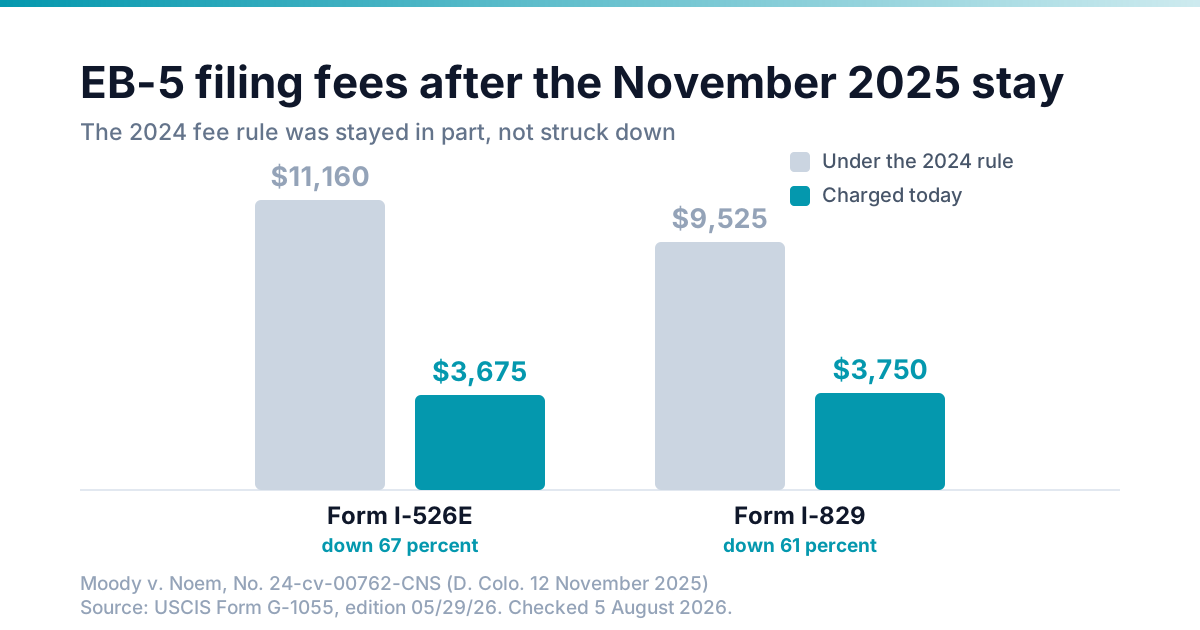
An investor filing Form I-526E today pays USCIS $3,675, and Form I-829 costs $3,750. Those are the amounts that applied before April 2024, and they are back because a federal court in Colorado stayed part of the 2024 fee rule on 12 November 2025. The rule was not struck down. The court stayed its EB-5 provisions and left the rest standing, which is why the fees at the adjustment stage did not move at all.
What the court actually decided
The case began on 19 March 2024 as Moody v. Mayorkas, filed in the United States District Court for the District of Colorado by an individual EB-5 investor, the American Immigrant Investor Alliance and ITServe Alliance. After the routine substitution of a new Secretary of Homeland Security as defendant, the November 2025 decision and USCIS both call it Moody v. Noem, No. 24-cv-00762-CNS. If you search the old name you will still find the docket, but the current caption is the one to cite.
The plaintiffs lost their first attempt. On 29 March 2024 the court refused to block the new fee schedule, so the increase took effect on 1 April 2024 as planned and USCIS collected the higher amounts for more than eighteen months.
The ruling that changed things came on 12 November 2025, and its remedy matters as much as its reasoning. The court granted a stay under 5 U.S.C. 705 rather than vacating the rule, and said in terms that vacatur would be improper. A stay suspends the operation of specific provisions. It does not erase them, and it can be lifted. Writing that the fee increase was overturned, blocked or thrown out, as several summaries did, describes something the court declined to do.
The reasoning was narrow and specific to EB-5. Section 106 of the EB-5 Reform and Integrity Act of 2022 sets an order of operations: complete a study of what EB-5 adjudications actually cost, then set the fees. USCIS set the fees first. The court held that doing so was contrary to law and stayed the EB-5 fees the rule had imposed without the study to guide them. It described the effect as leaving the vast majority of the rule intact, which is exactly what happened.
Why the relief reaches everyone, not just the plaintiffs
A detail in the order explains why an investor with no connection to the case pays the lower fee anyway. The plaintiffs did not establish standing to challenge the whole schedule. The court found they had shown it only as to particular charges, among them the Form I-829 fee, certain H-1B fees and the Asylum Program Fee, and the narrowness of the relief follows from that narrowness of standing.
That raised an obvious problem. In 2025 the Supreme Court sharply limited the practice of granting relief to the world at large in Trump v. CASA, Inc., 606 U.S. 831. The court here addressed it directly and concluded that those limits did not constrain what it was doing, because a stay under 5 U.S.C. 705 operates on the challenged provisions themselves rather than applicant by applicant. Suspend the provision and it is suspended for everybody who would otherwise be charged under it. USCIS implemented it that way, for all filers.
One claim was left undecided. The plaintiffs also argued that the administrative record behind the rule was too thin to support its reasoning. The court did not reach that argument, so it survives if the case continues.
Which fees moved and which did not
The fee schedule rule published on 31 January 2024 repriced most of what USCIS charges. The stay reached only the EB-5 forms.
Back to their earlier amounts:
- Form I-526, the standalone investor petition, from $11,160 to $3,675
- Form I-526E, the regional center investor petition, from $11,160 to $3,675
- Form I-829, removal of conditions, from $9,525 to $3,750
- Form I-956, regional center designation, from $47,695 to $17,795
- Form I-956F, approval of an investment in a commercial enterprise, from $47,695 to $17,795
- Form I-956G, the regional center annual statement, from $4,470 to $3,035
Untouched, and this is the part most often reported wrongly:
- Form I-485 remains $1,440 on paper and $1,390 online. The reduced $950 paper and $900 online rate applies only to an applicant under 14 who files at the same time as the Form I-485 of one parent. A child under 14 filing alone pays the full amount.
- Form I-765 remains $520 on paper and $470 online. The widely quoted $260 is a conditional rate for someone who filed Form I-485 with a fee on or after 1 April 2024 and whose application is still pending.
- Form I-131 remains $630 on paper and $580 online for advance parole alongside a pending adjustment application. A reentry permit is $630 with no online option.
- The $600 Asylum Program Fee paid by employers was challenged in the same case and upheld. So were the increases for H-1B, L-1 and O-1 petitions.
Biometrics is no longer billed separately on any form an EB-5 applicant files. The 2024 rule folded that charge into the form fees, and the stay did not disturb it.
Where the real numbers live now
USCIS moved quickly. It announced compliance and began charging the earlier EB-5 amounts from 13 November 2025, the day after the order, while saying on the record that it believes the decision is incorrect.
There is a practical trap here worth more than the legal detail. No USCIS page for an individual form states a dollar amount any more. The pages for Form I-526E, Form I-829 and Form I-956F all send you to the fee schedule instead. That schedule is Form G-1055, and the figures in this article come from edition 05/29/26 of it, read on 5 August 2026. G-1055 carries an edition date that changes, so quote the edition alongside the number.
Do not take a fee from the regulation. Part 106 of title 8 is the right place to understand how USCIS fees are structured, but it was never amended after the stay. It still lists $11,160 for Form I-526E and $9,525 for Form I-829. Those amounts are unenforceable and USCIS will not accept them, yet they sit there looking authoritative, and any page built by copying the regulation carries them forward.
The rejection rule that catches late filers
USCIS gave a short transition and then closed it. From 26 November 2025 a filing that tenders the April 2024 EB-5 amount is rejected rather than receipted. A rejected filing is not a pending filing, so the practical cost of paying too much is losing the filing date, not merely overpaying.
Nothing in the order or the agency alert requires anyone to refile a petition that was properly submitted with the higher fee while it was the published amount. Those cases were correctly filed under the schedule in force at the time, and USCIS kept accepting that amount until 26 November 2025.
If you are consular processing rather than adjusting
An investor who completes the process at a consulate abroad never files Form I-485, Form I-765 or Form I-131, so none of the adjustment-stage amounts above apply. What does apply is the USCIS Immigrant Fee of $235, payable by each person immigrating as a lawful permanent resident. It is easy to leave out of a budget precisely because it is not a petition fee and arrives at the end rather than the beginning.
One more mechanic worth knowing wherever it applies: the 2024 rule introduced a flat $50 discount for filing online rather than on paper. That is why Form I-485 shows as $1,440 and $1,390, and Form I-131 as $630 and $580. The EB-5 petitions themselves have no online option, so the discount never reaches Form I-526E or Form I-829.
The Integrity Fund is set by Congress, not by DHS
One set of EB-5 charges could not be touched by this litigation, and understanding why explains the shape of the whole dispute. A court reviewing agency action can suspend a fee that DHS set in a regulation. It cannot suspend a fee that Congress wrote into statute.
The EB-5 Integrity Fund charges sit in 8 U.S.C. 1153(b)(5)(J), added by the 2022 statute. They are unaffected and still collected:
- $1,000 with an initial Form I-526E. It does not apply to an amendment, and it never applies to the standalone Form I-526.
- $20,000 a year from each designated regional center, reduced to $10,000 for a regional center with 20 or fewer investors in the preceding fiscal year. This is the charge the fee schedule itself labels the Integrity Fund Fee, and it falls on the sponsor rather than the investor.
The annual charge is due on 1 October, payable without penalty through 31 October, and a regional center that has not paid by 30 December faces termination. That deadline has teeth, and it is a live part of post-2022 compliance rather than a formality. Note that the statute lets the Secretary raise these amounts by regulation and gives no power to lower them.
What happens to money already paid
This is the question investors ask first and the one with the least satisfying answer. Between 1 April 2024 and November 2025, EB-5 petitioners paid roughly three times the current figure. The court ordered no refunds, and the order does not address money already collected. USCIS has published nothing on the subject in the months since.
The default runs against refunds. The USCIS Policy Manual treats filing fees as generally non-refundable regardless of how a case turns out, with narrow exceptions built around agency error and reached by written request. Whether a later stay converts a payment that was lawful when made into a refundable overpayment is unresolved, and commentary on it contradicts itself. Anyone who paid the higher amount should put the question to their own counsel rather than to a fee page.
The replacement rule already proposed
The court expected this to be temporary. Its reasoning noted that a properly issued rule, this time built on the study section 106 requires, would presumably follow and would likely end the case.
That rule exists in draft. DHS proposed a dedicated EB-5 fee rule on 23 October 2025 with the required fee study attached, and the comment period closed on 22 December 2025. It proposes $9,625 for Form I-526 and for an initial Form I-526E, $7,860 for Form I-829, $28,895 for Form I-956 and $29,935 for Form I-956F.
Those figures are presented as reductions, because the draft was written before the ruling and measures itself against the April 2024 schedule. Measured against what an investor pays today, every one of them is a large increase. For a regional center investor the gap is close to $6,000. No final rule has issued and no effective date has been set, so nothing here is payable yet, but the direction is not ambiguous.
What is genuinely unknown
Three things a careful reader should not be told with confidence, because nobody can support them.
The first is what has happened in the case recently. The court ordered a joint status report for 12 January 2026, and the public docket record runs out shortly afterwards. Whether the case was held pending the rulemaking, whether the government appealed, and whether anything has been decided since are not established from the public record.
The second is timing. A federal regulatory agenda lists final action on the replacement rule for September 2026. Agenda dates slip as a matter of routine and are not commitments.
The third is whether a new rule would reach petitions already filed. USCIS fee changes have historically applied by postmark to new filings, and the proposal says nothing about pending cases.
What to do next
- Check Form G-1055 on the day you file and note its edition date, because it is the only source USCIS treats as current and it is the number the lockbox applies. Pay each concurrently filed form separately.
- If you are filing Form I-526E, budget the $1,000 Integrity Fund charge on top of the $3,675 filing fee, and confirm the petition is an initial filing rather than an amendment before paying it.
- Treat today's amounts as a window rather than a settled price, and read them alongside the costs beyond the investment and the $800,000 and $1,050,000 thresholds, which the litigation did not touch at all.
Sources
This page is written from primary sources published by the United States government. Last updated August 5, 2026. It is general information about how the EB-5 programme works, not legal advice about your case.
- Federal Register, the 2024 USCIS fee rule
- USCIS alert on the court order staying the 2024 fee rule
- Form I-526E, petition by a regional center investor
- Form I-829, removing the conditions on residence
- Form I-956F, approval of an investment in a commercial enterprise
- USCIS fee schedule, Form G-1055
- 8 CFR Part 106, how USCIS sets its fees
- 8 U.S.C. 1153, how immigrant visas are allocated
- USCIS Policy Manual on filing fees and refunds
- Federal Register, the proposed EB-5 fee rule
- USCIS fee schedule, Form G-1055 as a PDF
Topics on this page: EB-5 Immigrant Investor Program, EB-5 Regional Center, EB-5 Reform and Integrity Act of 2022, Form I-526E.