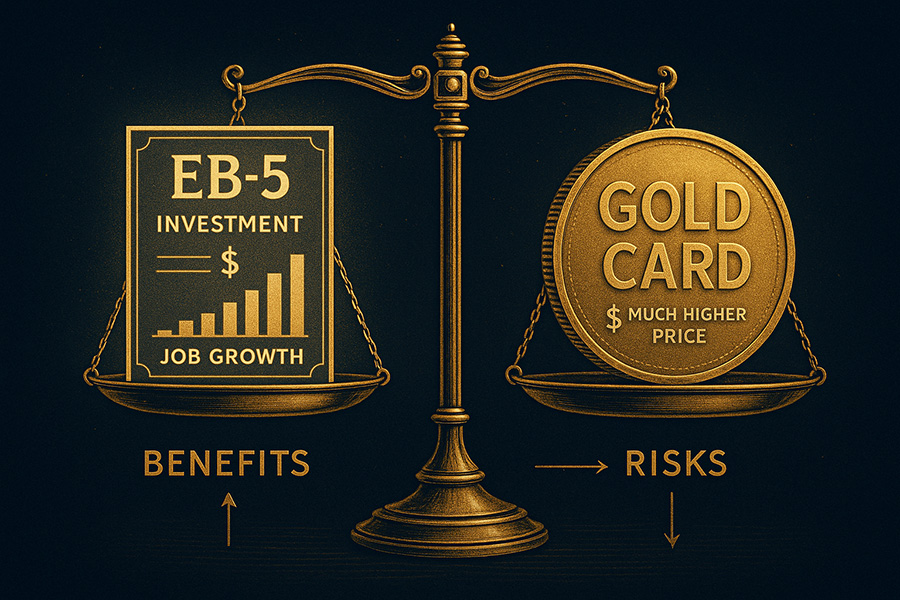
EB-5 and the proposed Gold Card differ in three ways that matter before any of the politics: what happens to your money, whether jobs are required, and whether the pathway exists in law. EB-5 requires an investment of $800,000 in a targeted employment area or $1,050,000 outside one, kept genuinely at risk in a business that creates 10 full-time jobs, and the capital can be returned once conditions are removed. The Gold Card as described publicly is a payment to the United States government, with no job creation obligation and no way to get the money back. EB-5 is codified in statute and has been adjudicated for decades. The Gold Card is a proposal.
The EB-5 visa requirements as they stand
The requirements are specific and they are testable. You invest $800,000 if the project sits in a targeted employment area, meaning a rural area or an area of high unemployment, and $1,050,000 if it does not. Those amounts are fixed until the first inflation adjustment on 1 January 2027. The money must go into a new commercial enterprise, must be genuinely at risk rather than guaranteed, and must be traceable to a lawful source. Ten full-time positions for qualifying United States workers must be created and attributed to your investment.
Procedurally you file Form I-526E for regional center investors, receive two years of conditional permanent residence, and then file Form I-829 to remove the conditions by proving the jobs were created and the capital was sustained. The program overview sits on the USCIS EB-5 Immigrant Investor Program page. For the amounts and how targeted employment area status is proved, see Minimum Investment Amounts and TEA: How Much is Required?.
What the Gold Card proposal is, and what it is not
The Gold Card has been described as a route to permanent residence granted in exchange for a large payment made to the government rather than invested in a business. Figures floated publicly have ranged from around $1 million for an individual to $5 million at the top end, and the reported terms have shifted more than once. Treat every number you read as provisional, including the ones in this paragraph.
What has not happened is the part that decides everything. Congress has not enacted a new immigrant visa category. The classes of employment based immigrant visas and their annual numerical limits are set in 8 U.S.C. 1153, the statute governing employment based immigrant visa allocation. An administration can change how it processes applications inside those categories. It cannot invent a new one or reassign the numbers by announcement. Any implementation attempt that stretches that boundary invites litigation, and litigation over immigration programs routinely runs for years.
Investment versus payment, and why the distinction is not semantic
Under EB-5 your $800,000 remains your capital. It is exposed to real loss, which is the point of the at risk requirement, but if the project performs, the loan is repaid or the equity is redeemed and the money comes back to you. Investors underestimate how much this matters. Over a typical hold period the true cost of EB-5 is the legal fees, the administrative fee charged by the fund, the foregone return on the capital, and the risk of loss, not the $800,000 itself. That arithmetic is laid out in The Real Cost of EB-5: Fees and Expenses Beyond the Investment, and the risk side is explained in Capital at Risk: What Does It Mean in EB-5?.
A payment to the government is different in kind. It is spent, not held. There is no project to diligence, no exit to negotiate, and no scenario in which it comes back. If the program is later struck down, restructured or simply never implemented, the question of refunds would be governed by whatever terms the government wrote, and nobody should assume those terms will be generous.
Job creation is the requirement the Gold Card drops
EB-5 exists because Congress wanted foreign capital to produce American employment. That is why the 10 job rule survives every reform round, and why removal of conditions turns on proof of jobs rather than proof of payment. Regional center investors can count indirect and induced jobs modeled by an economist, which is a real advantage, but the model still has to hold up. How that works is set out in Job Creation Requirement: How EB-5 Creates 10 Jobs.
A payment-based route severs that link entirely. Politically that is the weakest point of the proposal, because the defense of investor immigration has always rested on the economic development argument. Strip out job creation and what remains is the thing critics have always accused EB-5 of being. That fight is old, and it is summarised in EB-5 Under Scrutiny: Common Criticisms of the Program.
The deadlines that make waiting expensive
EB-5 has dates on the calendar that a wait-and-see strategy runs into. The regional center program is authorized through 30 September 2027. Petitions filed by 30 September 2026 are grandfathered, meaning they continue to be processed even if the program lapses afterwards. The first inflation adjustment to the investment amounts lands on 1 January 2027. The framework behind all three comes from the EB-5 Reform and Integrity Act of 2022 as enacted.
Someone who defers an EB-5 filing while waiting to see whether a Gold Card materialises can lose grandfathering protection and face a higher investment threshold, in exchange for a pathway that may never be enacted. That is an unfavorable trade under most assumptions. Sunset 2027: What If Congress Fails to Extend the RC Program? covers the downside scenario in detail.
How to think about the comparison if you are deciding this year
Ask what you are actually buying. With EB-5 you are buying a regulated, litigated, well understood process with known failure modes: project failure, denied petitions, visa backlogs, and job shortfalls. Those risks are manageable with diligence and a good attorney. With a scheme that does not yet exist, you are buying regulatory risk you cannot diligence at all, at a higher price, with no capital return.
None of that means the Gold Card is irrelevant. If it were enacted with meaningful volume, it could reshape demand, pricing and even visa allocation for investor immigration generally. Track it. Follow the rulemaking record through the Federal Register search for EB-5 documents rather than press coverage, because proposals become real when they appear there. Until they do, the comparison is between a functioning statute and a press release.
Related reading
Sources
This page is written from primary sources published by the United States government. Last updated August 5, 2026. It is general information about how the EB-5 programme works, not legal advice about your case.
- Form I-526E, petition by a regional center investor
- Form I-829, removing the conditions on residence
- USCIS on the EB-5 Immigrant Investor Program
- 8 U.S.C. 1153, how immigrant visas are allocated
- Public Law 117-103, the EB-5 Reform and Integrity Act of 2022
- Federal Register
Topics on this page: EB-5 Immigrant Investor Program, Targeted Employment Area, EB-5 Regional Center, EB-5 Reform and Integrity Act of 2022.