
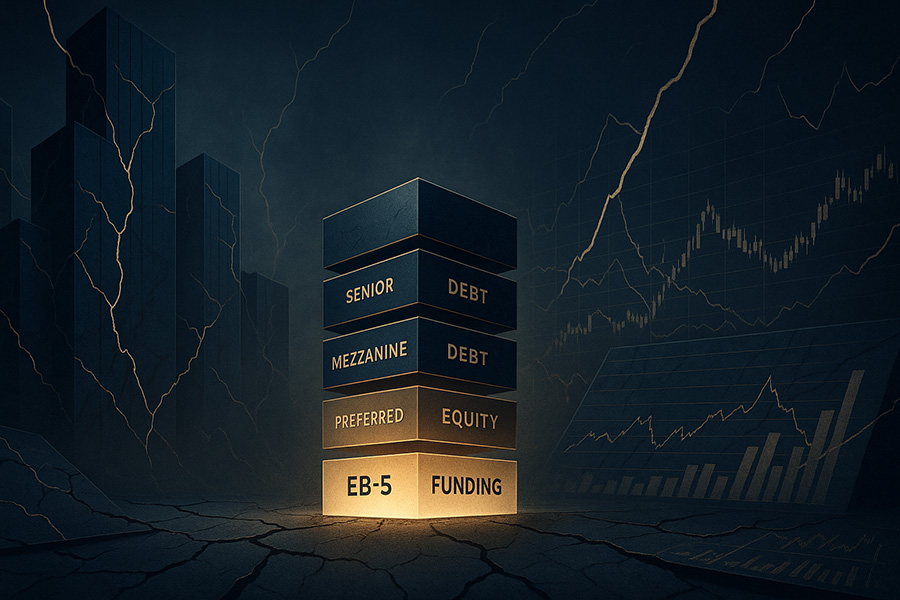
The lesson The Big Short and Margin Call hold for an EB-5 investor is that catastrophic losses come from the capital structure and from whose interests get protected first, long before any of it shows up in the marketing. Both films follow people discovering that a position they believed was safe was actually junior, heavily leveraged and dependent on assumptions nobody stress tested. An investor writing a check for $800,000 into a pooled EB-5 fund sits in a structurally similar seat: subordinated to a senior construction lender and dependent on a developer's refinancing, holding an instrument whose real terms live in a document most subscribers skim. One difference matters. A failed EB-5 project can cost the money and the green card.
The one lesson worth $800,000
Both films turn on one discovery: risk had been repackaged until the people holding it could no longer see it.
EB-5 is sold as an immigration product. Financially it is a private placement into a single illiquid project, usually through a new commercial enterprise that lends the pooled money to a job creating entity. Two outcomes are on the table for you. One is return of your capital. The other is approval of Form I-829 to remove conditions after two years of conditional residence, which requires ten full time jobs per investor and capital that stayed at risk.
Those two outcomes are less correlated than most investors assume. That is the part worth sitting with.
How leverage hides inside a clean looking deal
Take a hypothetical $200 million development. A senior construction lender puts in $120 million, an EB-5 fund raises $40 million from 50 investors at $800,000 each, and the sponsor contributes $40 million of equity. On a glossy summary that reads as a well capitalized project.
Now apply a 15 percent cost overrun and a two year delay in opening. Senior debt is first in line and holds a mortgage on the asset. Sponsor equity absorbs losses first in theory, though the sponsor also controls the timing of every decision. EB-5 money sits between the two, and in a workout the middle is where negotiating power is thinnest.
Leverage is what makes a modest shock lethal. That mechanic is what The Big Short dramatizes with derivative structures layered on a comparatively small pool of underlying mortgages, and it is what turns a delayed hotel opening into a total loss for a subordinated lender.
Where EB-5 money actually sits in the capital stack
Two structures dominate the market. In the loan model, the new commercial enterprise lends to the job creating entity and expects repayment from a refinancing or a sale. In the equity model, the fund holds preferred equity with a redemption right that only functions if there is cash to redeem with.
Either way, read the intercreditor agreement. Senior lenders routinely require the EB-5 position to stand still, meaning no acceleration and no enforcement while the senior loan is outstanding. Standstill provisions are legitimate and common. They also mean that when things go wrong you have no lever to pull.
Sponsor guarantees deserve equal skepticism. A completion guarantee from a single purpose entity with no assets is decoration. A guarantee from a balance sheet you can inspect is worth something. Ask which one you have. Differences between pooled offerings and standalone deals are covered in our page on direct investment versus pooled Regional Center funds.
Read the PPM the way an analyst reads a model
The private placement memorandum is the one document obliged to tell you the truth about the deal, and it is written to survive litigation rather than to be pleasant reading. Start at the back. Risk factors, use of proceeds and the exit assumptions carry more information than the executive summary ever will.
Four specifics deserve real attention.
- Fees. Offering costs and ongoing management charges reduce what actually reaches the project. An $800,000 subscription that delivers $720,000 to construction has a different risk profile from one that delivers $790,000.
- Job creation math. Economic reports rely on multiplier methods such as RIMS II or IMPLAN. What matters is the cushion above the ten full time positions each investor needs, because a model landing at exactly ten per investor leaves nothing for a delayed opening.
- Escrow. Find the trigger that releases your money, and whether release happens before or after Form I-956F has been filed for that offering.
- Exit event. Identify what specifically repays you, and what the fund does if it has not happened by the stated date.
Jobs are counted under 8 CFR 204.6, and the regulation excludes combinations of part time positions even when the hours add up to a full week. A job-sharing arrangement, where two employees share one full time position, does count. Full text sits on the eCFR page for 8 CFR 204.6.
Whose survival comes first when a project fails?
Margin Call answers that cleanly. The institution protects itself, and the people with the least information absorb the outcome.
A distressed EB-5 project follows the same ordering. Senior lenders enforce their security. Sponsors protect their fee stream and their relationships with the lenders they need for the next deal. A Regional Center protects its designation, because losing it threatens every offering it has ever raised. You are last in that sequence, and you usually learn what happened months after the decisions were made.
Congress built one narrow protection into this. Under 8 U.S.C. 1153(b)(5)(M), titled Treatment of Good Faith Investors Following Program Noncompliance, an investor whose Regional Center is terminated or debarred gets a 180 day window to take remedial action rather than losing the petition outright. That provision is a lifeline for the immigration side of the problem. It does nothing for the money. Statutory text sits on the House US Code page for 8 U.S.C. 1153.
History supports the caution. The Regional Center program lapsed in 2021 and left investors with pending petitions in limbo until the 2022 Act restored it, and the reforms in that Act grew out of a decade of documented abuse traced in our page on the reform fights from 2015 to 2018.
Immigration risk and money risk are two different failures
A project can lose money, sustain the investment for the required period and still create ten qualifying jobs per investor. Conditions come off on the I-829 and the capital does not come back. Status survives the loss.
It runs the other way too. A profitable project whose job model falls short, or whose Regional Center is debarred, can return every dollar and still leave a family without status. Model both failure modes separately when you evaluate an offering.
One structure fails on both fronts at once. Any arrangement that guarantees the return of your $800,000, whether through a buyback right or a redemption obligation, undermines the capital at risk requirement USCIS applies under Volume 6, Part G of the USCIS Policy Manual. A promise of safety is a warning sign in this program.
Ask the questions a sponsor would rather skip
Timing questions come first, and one of them is routinely answered wrong in the market. An investor may file Form I-526E as soon as the Regional Center has filed Form I-956F for that specific offering. USCIS must approve the I-956F before those petitions can be approved, and holding back your filing until the approval arrives simply surrenders months of priority date for nothing. Our page on exemplar approval and Form I-956F sets out the sequence.
Then ask the harder ones. How much senior debt sits ahead of the EB-5 tranche, and on what terms. What does the intercreditor agreement permit you to do in a default. How many investors from this Regional Center have reached I-829 approval. Which specific event returns the capital, and what happened to the sponsor's previous projects.
Marketing pressure is a signal in itself. When an offering is promoted with urgency about a closing deadline, check whether the urgency belongs to the deal or to the sales channel, a distinction our page on how EB-5 projects market themselves unpacks. No federal agency vets the investment merits of a private offering, a point made plainly in the SEC investor alert on claims that the SEC has approved an offering. USCIS maintains its own list of common immigration scams.
Characters in both films who came out intact did the unglamorous work of reading the underlying documents and counting the actual loans. That work is available to you. It takes an independent immigration attorney, a securities lawyer who will read the PPM, plus a willingness to walk away from any deal that refuses to answer questions in writing.
Program deadlines add a genuine clock. Authorization for the Regional Center program runs through 30 September 2027. Petitions filed on or before 30 September 2026 are grandfathered under 8 U.S.C. 1153(b)(5)(S). Thresholds of $800,000 in a Targeted Employment Area and $1,050,000 outside one receive their first inflation adjustment on 1 January 2027. Urgency about the statute is real. Urgency about one particular project usually is not.
Related reading
Sources
This page is written from primary sources published by the United States government. Last updated August 5, 2026. It is general information about how the EB-5 programme works, not legal advice about your case.
- 8 CFR 204.6, petitions for employment creation immigrants
- 8 U.S.C. 1153, how immigrant visas are allocated
- USCIS Policy Manual, Volume 6 Part G on EB-5
- SEC investor alert on claims that it approved an offering
- USCIS on common immigration scams
Topics on this page: EB-5 Immigrant Investor Program, EB-5 Regional Center, Form I-526E, Form I-829.