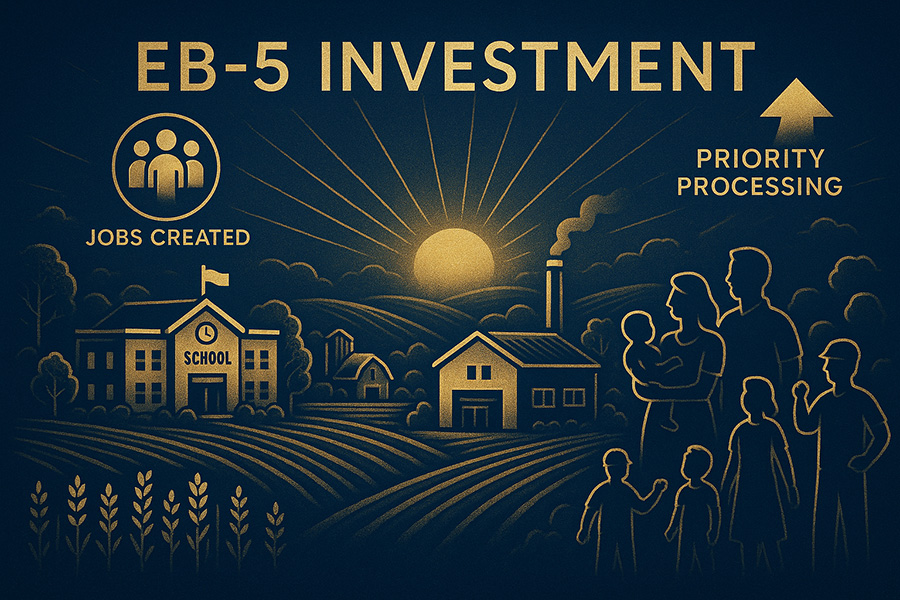
Rural EB-5 projects change small American towns because the same $800,000 goes much further where there is less of everything. A clinic, a food processing plant, a hotel or a fiber network funded with EB-5 capital in a county of a few thousand people is often the largest private investment made there in a generation. For the investor, rural carries two advantages that cannot be bought anywhere else in the program: 20 percent of the annual EB-5 visa supply is reserved for rural investments, and Congress told USCIS to give rural petitions priority in processing. That combination, not sentiment about small towns, is why rural has absorbed so much of the market since 2022.
What rural means in the statute, not on a map
Rural has a legal definition and it is narrow. The project must sit outside every metropolitan statistical area and outside the outer boundary of any city or town with a population of 20,000 or more. Both halves matter. A valley twenty minutes from a mid sized city usually fails the first test even though it looks rural from the car window. Before you take a sponsor at their word, check the metropolitan half of the question against the Census Bureau delineations of metropolitan and micropolitan statistical areas.
A rural area qualifies as a Targeted Employment Area, so the investment is $800,000 rather than $1,050,000. Those figures hold until the first inflation adjustment on 1 January 2027. If the location designation is wrong, everything built on top of it is wrong too: the amount you invested, the visa category you filed under and the processing priority you were promised. This is the one fact in a rural offering worth verifying independently, and it is covered in more depth in TEA Redefined: Targeted Employment Areas After RIA 2022.
What the set aside and priority processing actually give you
Reserved visas. The EB-5 Reform and Integrity Act of 2022 reserved 20 percent of the annual EB-5 allocation for rural investments, 10 percent for projects in areas of high unemployment and 2 percent for qualifying infrastructure. Reserved visas are counted in their own lane, so an investor from a heavily backlogged country who files in the rural category is not queued behind the entire unreserved population. For many Indian and Chinese families that is the whole reason rural is on the table. The allocation language sits in Public Law 117-103, which contains the EB-5 Reform and Integrity Act if you want to read it rather than hear it summarized.
Priority processing. The same law directs USCIS to prioritize adjudication of rural petitions. Priority is not premium processing and it is not a guaranteed date. It means a properly filed Form I-526E petition for a regional center investor should be reached ahead of comparable unreserved filings. Rural adjudications have in fact moved faster than unreserved ones, but the speed depends entirely on how many rural petitions are already sitting in front of yours.
What a rural project that actually works looks like
- Job creation with real margin. Ten jobs per investor is the floor, not the target. A credible deal shows a cushion, so a delayed phase or a smaller build still clears the requirement for everyone in the raise. Ask for jobs per investor at full subscription, not the gross project number in the brochure.
- A sponsor who has finished something rural before. Building in a thin market is a different skill from building in a city. Labor has to be imported or trained, materials travel further, and there is no deep bench of subcontractors when one of them fails.
- Demand that exists without the project. The durable rural stories serve something the area already needs: a hospital where the nearest alternative is an hour away, a processing plant beside the farms that supply it, broadband where there is none.
- A capital stack that survives a slow raise. If construction cannot start until the last EB-5 dollar lands, your money sits idle and the job creation clock does not start.
- An exit somebody has thought about. Rural assets can be harder to refinance or sell. Ask directly what happens if the property does not trade at the projected price on the projected date.
The kinds of rural deals that keep appearing
Agricultural and food processing. These sit naturally in rural counties, employ steadily once operating and tie into an existing supply chain of local growers. Operating jobs, rather than construction jobs, tend to carry the count.
Healthcare. Hospitals, clinics and senior care create high wage permanent positions and answer a shortage that rural counties feel acutely. They are also operationally complex, and staffing a rural facility is harder than building one.
Hospitality and tourism. Lodges and resorts near parks, lakes and ski areas raise well because the story is easy to tell. Judge them on occupancy assumptions, not photographs.
Renewable energy and broadband. Utility scale solar, wind and fiber networks are construction heavy and employ relatively few people once running, so scrutinize how much of the job count comes from the construction period.
Light manufacturing and logistics. Distribution and assembly facilities placed along highway corridors can qualify as rural while still reaching large markets.
Where rural projects go wrong
The workforce problem is the honest one. A project that needs a couple of hundred employees in a county with a small labor pool has to pull workers from a wide radius or relocate them, and that shows up as delayed hiring, wage pressure and slower job creation. You can sanity check the local picture with the Bureau of Labor Statistics local area unemployment statistics instead of relying on the sponsor's economic report alone.
Concentration is the second problem. In a small economy one anchor tenant, one buyer or one employer can carry the entire thesis, and if that party walks, there is no second bidder next door. The third is distance. Very few investors will ever visit a site four hours from an airport, which puts more weight on the reporting you receive and on the operator's willingness to answer awkward questions. Regional centers are subject to annual reporting and USCIS oversight after the 2022 reforms, and that oversight is described in Regional Center Compliance and Oversight, but oversight is not a substitute for your own diligence.
Questions worth asking before you wire
- Which specific test makes this site rural, and what evidence is in the offering file?
- How many qualifying jobs per investor does the model produce at full subscription, and how many of those are construction rather than operating jobs?
- What has the sponsor built in a comparable market, and can you speak to an investor from that earlier deal?
- Is the EB-5 money senior, mezzanine or equity, and who gets paid before you do?
- What is the plan if the raise closes at half its target?
- Who administers the fund, and how often will you receive job creation updates you can use for your Form I-829 petition to remove conditions?
Timing, because the rural advantage is being consumed
Reserved categories only stay fast while few people use them. Rural has been the most popular set aside since the reforms took effect, and each new filing narrows the gap between the rural queue and the unreserved one. Two dates matter more than any market forecast. Petitions properly filed by 30 September 2026 are grandfathered and continue to be processed even if the regional center program lapses, and the current authorization runs to 30 September 2027. After approval you receive two year conditional residence and must then prove sustained investment and job creation. The mechanics of the reserved lanes are set out in Visa Set-Asides: How They Work, and the official program summary is on the USCIS EB-5 Immigrant Investor Program page.
The community side, without the brochure
The jobs are real, and so is the effect on a town that has not seen new construction in twenty years. Treat the impact numbers with more care than the story. Economic impact reports use multipliers, and a large indirect job figure reflects a model assumption as much as an outcome. Ask which model was used, which inputs drive it and what happens to the count if the project opens a year late. A sponsor who answers that clearly is telling you something useful about how they will handle everything else.
Related reading
Sources
This page is written from primary sources published by the United States government. Last updated August 3, 2026. It is general information about how the EB-5 programme works, not legal advice about your case.
- Census Bureau, metropolitan area definitions
- Public Law 117-103, the EB-5 Reform and Integrity Act of 2022
- Form I-526E, petition by a regional center investor
- Bureau of Labor Statistics
- Form I-829, removing the conditions on residence
- USCIS on the EB-5 Immigrant Investor Program
Topics on this page: EB-5 Immigrant Investor Program, Targeted Employment Area, EB-5 Regional Center, EB-5 Reform and Integrity Act of 2022.