
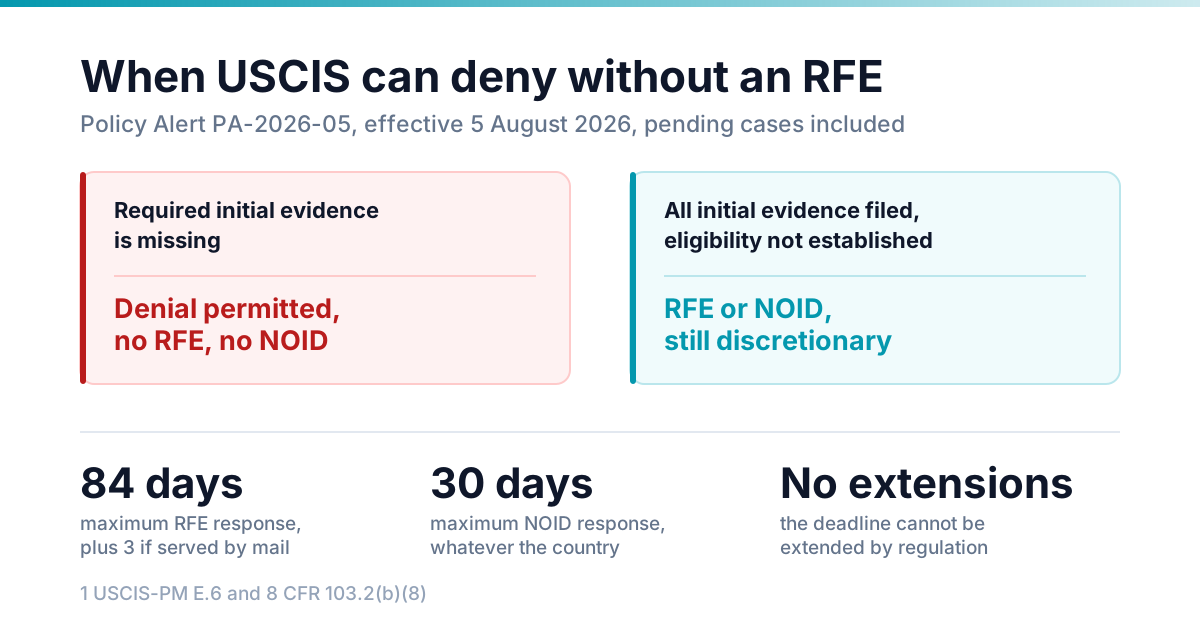
USCIS can now deny an EB-5 petition without asking for the missing paperwork first. Policy Alert PA-2026-05, published on 5 August 2026, rewrote Chapter 6 of Volume 1, Part E of the Policy Manual and states plainly that the issuance of a Request for Evidence or a Notice of Intent to Deny is not required by regulation. The guidance took effect the day it was published, and it applies to benefit requests pending or filed on or after that date. A petition that has been waiting in the queue since 2024 is adjudicated under the new rules.
The two situations the alert separates
The change turns on a distinction that was always in the regulation but was softened by prior policy. 8 CFR 103.2(b) splits an inadequate filing into two cases, and USCIS now treats them differently.
If required initial evidence is missing, USCIS may deny the petition outright. No RFE, no NOID. Initial evidence is the threshold set by statute, regulation and the form instructions, and the Policy Manual describes it as what must accompany the request for it to be properly filed at all.
If all the initial evidence is there but it does not establish eligibility, an RFE or a NOID remains available. Even then it is discretionary rather than owed. The revised chapter gives the example of a document that satisfies the checklist while raising obvious questions about its own reliability, which is the situation a NOID was designed for.
Under the previous policy officers were instructed to issue an RFE or NOID in both cases. That instruction is gone. USCIS describes the old approach as having created opportunities for frivolous or substantially incomplete filings, and says it is restoring the discretion the 1994 regulations already granted.
The response clock changed too
This part travelled less well in the first round of coverage, and for EB-5 it may matter more than the headline. Twelve weeks was never a fixed period. The regulation sets it as a maximum, and officers now have express discretion to set a shorter deadline that reflects what is actually being asked for. Eighty four days is the ceiling, not the default.
USCIS also stopped adding fourteen days for notices mailed outside the United States. The regulation on service allows three days for anything sent by mail and nothing more, so an RFE mailed to Mumbai and an RFE mailed to Miami now run on the same clock. The maximum a mailed RFE can carry is 87 days from the date USCIS sent it. For a NOID the maximum is 30 days. Neither can be extended, because the regulation prohibits granting additional time.
Almost every EB-5 investor reads their mail somewhere other than the United States. Losing the international allowance is a straightforward reduction in the time available to answer, applied to the population least able to absorb it.
A partial response is a request for a decision
The fourth change in the alert is the one most likely to catch a well organised filer. The Policy Manual now sets out three ways to answer an RFE or a NOID: respond completely, respond partially, or withdraw. A partial response is treated as a request for a decision on the record, and the officer will decide on what is in the file.
Sending the bank statements that arrived while the tax records are still coming used to look like diligence. It now reads as an instruction to rule. Anything short of the full answer should be weighed against simply using the whole period and filing once.
Why EB-5 is more exposed than most categories
The evidence an EB-5 petition rests on is slower to obtain than the evidence behind most benefit requests. Proving that the investment capital is lawful means assembling bank records, tax filings, property transfers and corporate documents, frequently from institutions in another country and another language, and frequently for transactions from years earlier. Our note on what source of funds tracing now requires covers where the line sits after the 2026 ruling.
A translated bank certification that takes six weeks to arrive is a different proposition when the deadline is 84 days and cannot be moved, and a materially different one when the officer has set 45 days instead. The same applies at the second stage, where proving job creation and sustained investment depends on developer records the investor does not hold and cannot compel quickly.
The placeholder filing is the actual target
The alert is unusually direct about motive. It says the prior policy was exploited to secure ancillary benefits associated with the benefit request, and that incomplete filings gave some requestors an unfair advantage in obtaining priority dates while others waited to assemble their evidence.
In EB-5 that describes a recognisable practice. Concurrent filing lets an investor already in the United States submit Form I-485 alongside the petition and obtain work and travel authorisation while it is pending, and a filing date locks a place in the queue. We have written about the appeal of that combination and about splitting an investment to secure a date. Neither is improper. But a petition filed thin on the assumption that an RFE will arrive to fill the gaps is precisely the filing this policy is written to stop, and the ancillary benefits do not survive a denied petition.
What counts as initial evidence
The form instructions decide this, not the officer's view of how strong the case is. The instructions for Form I-526E and Form I-829 are the operative checklist, and anything they require is now load bearing in a way it was not before. A missing signature, an unfiled schedule, a document listed in the instructions and left out of the package: each is a candidate for denial rather than a candidate for an RFE.
This is not the same as needing to win the case at filing. Evidence that is complete but unpersuasive still falls in the second category, where an RFE or NOID is available. The distinction is between an incomplete package and a weak one.
What has not changed
The burden of proof has always been on the requestor, and the approval standards are untouched. RFEs have not been abolished and will keep being issued. The regulations governing refugee and asylum applications sit outside this guidance entirely. Chapter 9 of the same part, covering how a decision is rendered, received a single revised paragraph on denials for lack of legal basis.
Appeal and motion rights after a denial are also unchanged, though they are a poor substitute for an approval. Our wiki covers the outcomes an I-526 can produce and what follows each, and separately the options after an I-829 denial.
What to do about it
File complete or do not file yet. The advantage of an early filing date is real, and it is now weighed against a denial risk that did not previously exist at the same level. Where the evidence is close to ready, waiting a few weeks may cost less than it appears to.
Reconcile the package against the form instructions line by line before submission rather than against a general sense of what a strong petition looks like. Our list of the mistakes that cause EB-5 cases to fail and the wiki entry on assembling the I-526 package are both organised around that checklist.
Make sure USCIS holds a current address and that someone can act on a notice quickly, since the clock starts when the notice is sent rather than when it is read. Investors abroad who relied on the fourteen day allowance should assume it is gone. And if an RFE does arrive, answer it once and answer it fully, because a partial response now asks for the decision.
The full text is worth reading directly. USCIS published it as Policy Alert PA-2026-05, and the revised guidance is cited as 1 USCIS-PM E.6, E.9 and E.10.
Sources
This page is written from primary sources published by the United States government. Last updated August 5, 2026. It is general information about how the EB-5 programme works, not legal advice about your case.
- Code of Federal Regulations (current/title-8/chapter-I/subchapter-B/part-103/subpart-A/section-103.2)
- USCIS (policy-manual/volume-1-part-e-chapter-6)
- Code of Federal Regulations (current/title-8/chapter-I/subchapter-B/part-103/subpart-A/section-103.8)
- Form I-526E, petition by a regional center investor
- Form I-829, removing the conditions on residence
- USCIS (policy-manual/volume-1-part-e-chapter-9)
- USCIS (sites/default/files/document/policy-manual-updates/20260805-EvidentiaryStandards.pdf)
Topics on this page: EB-5 Immigrant Investor Program, Form I-526E, Form I-829, EB-5 source of funds.