

🇺🇸English🇨🇳中文🇻🇳Tiếng Việt
EB-5 Legal Path
EB-5 US
HomeEB-5 WikiVisa BulletinCostRegional CentersGlossaryArticlesExpertsContact
Free Consultation - 24/7, Call +1 (920) 620-6969
Free Consultation - 24/7, Call +1 (920) 620-6969Call

EB-5 US

Independent EB-5 knowledge hub covering investment structures, compliance milestones, and attorney insight for families planning a residency by investment strategy.

EB-5 Projects & News

Resources

  • Visa Bulletin
  • Cost calculator
  • Regional centers
  • Glossary
  • Articles
  • Experts
  • HTML Sitemap

Company

  • Contact
  • Free Consultation - 24/7, Call +1 (920) 620-6969
  • +1 (920) 620-6969, Free Consultation - 24/7
  • No cost, no obligation
  • Email us

Legal

  • Disclaimer
  • Privacy Policy
  • Terms of Use
© 2026 EB-5 US. All rights reserved.
    1. Home
    2. Articles
    3. Concurrent Filing in 2026: A Fast Track to EAD, AP and Priority Date Lock
    Back to all articles

    EB-5 Concurrent Filing: I-526E With I-485 for EAD, Advance Parole

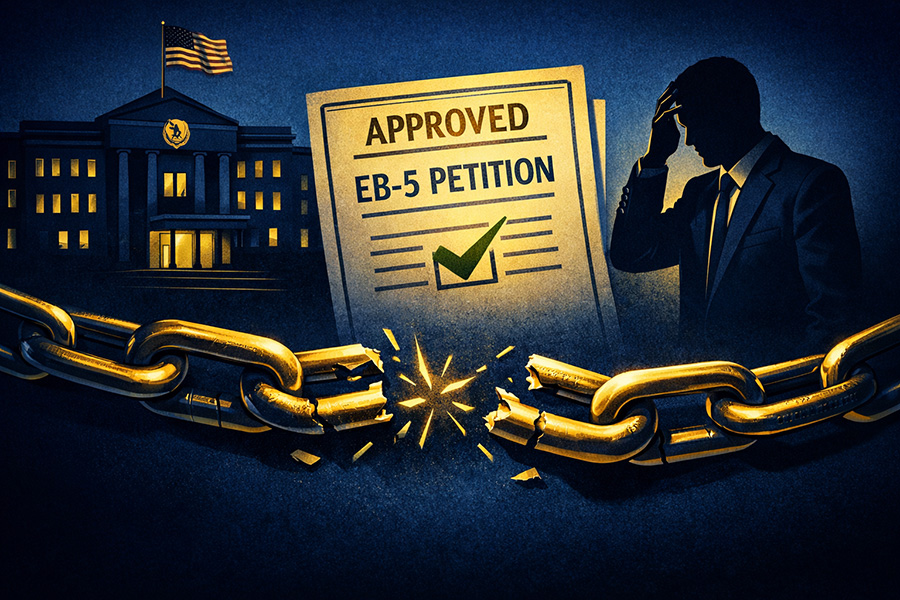
    Concurrent filing lets an EB-5 investor already inside the United States lodge I-526E and I-485 together, producing an employment authorization document and advance parole within months. The priority date locks on the day the petition is filed. A denied I-526E takes the adjustment application and both documents down with it.

    Tips
    March 1, 20266 min read
    Share LinkedIn Facebook Twitter (X) Copy link
    Concurrent Filing in 2026: A Fast Track to EAD, AP and Priority Date Lock

    On this page

    1. 1.Who can file I-526E and I-485 at the same time?
    2. 2.The three set-aside categories and why they matter here
    3. 3.Why an EAD changes an H-1B holder's life
    4. 4.Keep your underlying status until the EAD arrives
    5. 5.A denied I-526E takes the I-485 down with it
    6. 6.Time the filing against the 30 September 2026 deadline
    7. 7.Should dependents adjust or consular process?
    8. 8.Related reading

    Concurrent filing means lodging Form I-526E and Form I-485 in the same package, and it is open to an EB-5 investor already inside the United States in lawful status when a visa number is available in their category. The payoff arrives fast: a work permit and a travel document, usually within months, while the petition itself waits years in the adjudication queue. Your priority date locks on the day the I-526E is properly filed. For an Indian professional watching an employment based date crawl, that combination is the whole point.

    Who can file I-526E and I-485 at the same time?

    Three conditions have to line up. You must be physically present in the United States and otherwise eligible to adjust status. A visa number has to be available for your category in the month you file, which you check against the State Department's monthly Visa Bulletin. And the regional center must already have filed Form I-956F for the specific offering you are investing in.

    That last point trips people up constantly. Filing of the I-956F is what opens the door to your I-526E. Approval of the I-956F is what USCIS needs before your petition can be approved, which is a separate event on a separate timeline. Waiting for the approval before you file costs priority date and buys nothing.

    Money moves first. The $800,000 goes in and the subscription completes. Only then does the petition have a factual basis to stand on, because an I-526E filed against an unfunded subscription is a petition with no capital behind it.

    The three set-aside categories and why they matter here

    RIA reserved 20 percent of the annual EB-5 supply for rural projects, 10 percent for high unemployment areas and 2 percent for infrastructure. Those reserved lines are the reason concurrent filing became realistic for Chinese and Indian nationals at all, since the unreserved category has carried cut-off dates for years. Rural projects also receive priority processing of the petition under RIA, a separate benefit worth pricing into your project choice.

    Reserved does not mean permanently current. Those lines have been current for every country so far, but they are a fixed share of a capped annual supply, and the unreserved category shows what happens when demand catches up with the numbers. A strategy built this quarter on the assumption that rural stays open can stop working next quarter. Read the bulletin for the month you actually intend to file. Our guide to reading the EB-5 Visa Bulletin explains which chart governs filing.

    Why an EAD changes an H-1B holder's life

    Work authorization comes on Form I-765 and advance parole on Form I-131, both filed alongside the I-485. Once the employment authorization document arrives, you can work for any employer or launch a company of your own. Your spouse gets the same permission. That second part is the one people underestimate, because a household that has spent six years with one earner tied to one sponsoring employer suddenly has two people free to take any job in the country.

    Fees are not trivial and they change. Check current amounts on the USCIS filing fee page rather than on a sponsor's slide, and budget for the whole family rather than for yourself alone, since every dependent adjusting in the United States files an I-485 of their own.

    Keep your underlying status until the EAD arrives

    A pending I-485 gives you authorized stay while the application sits with USCIS. Status is a different thing, and the pending application evaporates the moment the underlying petition fails. Keeping valid H-1B status alive while the case is pending costs you very little and buys a genuine fallback.

    Travel deserves particular care. An H-1B or L-1 holder who maintains that status can generally travel on the visa without abandoning the adjustment application. An F-1 student who leaves and returns on advance parole comes back as a parolee, and the student status is gone. That matters if you were counting on OPT as a backup plan.

    Both documents are covered in detail in EAD and advance parole while your EB-5 I-485 is pending.

    A denied I-526E takes the I-485 down with it

    Denial of the petition ends the adjustment application in the same stroke. Employment authorization and advance parole die with it. If you left your H-1B employer eighteen months earlier on the strength of that EAD, you now hold no status at all and unlawful presence begins to accrue against you. Sit with that sequence before you resign.

    Expect requests for evidence on the investment side. Source of funds is where EB-5 petitions actually die, and the adjustment package brings its own medical examination and admissibility requirements on top of everything the petition demands.

    Published estimates on the USCIS processing times page are the only honest benchmark for how long any of this takes, and they shift month to month.

    Time the filing against the 30 September 2026 deadline

    Petitions filed on or before 30 September 2026 are protected by 8 U.S.C. 1153(b)(5)(S), headed Protection from expired legislation, so a filed petition keeps being processed even if regional center authorization lapses. Current authorization runs through 30 September 2027. The first inflation adjustment to the $800,000 and $1,050,000 minimums takes effect on 1 January 2027, which is a separate reason investors are compressing their timelines. Both dates are real. Neither is a sales tactic.

    Concurrent filing does not accelerate the I-526E itself. What it does is get you working and traveling while the petition waits, which for someone already living in the United States is usually worth more than a faster adjudication would be. Eligibility mechanics are laid out in who can file I-526E and I-485 together.

    Should dependents adjust or consular process?

    Splitting the family is permitted and sometimes sensible. A principal investor in the United States can adjust status while a spouse and children abroad go through consular processing. Plenty of families do exactly that. A spouse with no US status today and no intention of moving before the children finish a school year is often better served by an embassy interview than by a pending application filed from a country they do not live in. Derivatives are later included on the principal investor's Form I-829 rather than filing petitions of their own.

    Children approaching 21 need the arithmetic done early. The Child Status Protection Act subtracts the time USCIS took to adjudicate the petition from a child's age. It does not subtract years spent waiting for a visa number, and for a backlogged country that waiting is where nearly all the delay actually sits. Do the sum twice. Then run it past counsel, using our page on CSPA in EB-5.

    Indian filers face a particular set of trade-offs, gathered in EB-5 for Indian investors.

    Related reading

    • Concurrent Filing of I-526E and I-485: Who Can File Both Together
    • EB-5 EAD and Advance Parole: Work and Travel While Your I-485 Is Pending
    • EB-5 Visa Bulletin Explained: How to Read Priority Dates and Cut-Offs

    Sources

    This page is written from primary sources published by the United States government. Last updated August 5, 2026. It is general information about how the EB-5 programme works, not legal advice about your case.

    • State Department, the Visa Bulletin
    • Form I-956F, approval of an investment in a commercial enterprise
    • Form I-765, employment authorisation
    • Form I-131, travel document
    • USCIS on how filing fees work
    • USCIS processing times
    • 8 U.S.C. 1153, how immigrant visas are allocated
    • USCIS on consular processing

    Topics on this page: EB-5 Immigrant Investor Program, EB-5 Regional Center, Form I-526E, Form I-829.

    Key takeaways

    Concurrent filing lets an EB-5 investor already inside the United States lodge I-526E and I-485 together, producing an employment authorization document and advance parole within months. The priority date locks on the day the petition is fi

    Key topics

    concurrent filingI-526EI-485EB-5 investorsH-1B visaF-1 visa

    From the EB-5 Wiki

    Reference entries covering the rules behind this story.

    • Premium Processing for EB-5: Will It Speed Things Up?

      USCIS offers no premium processing for Form I-526 or I-526E, and Form I-907 cannot be used on an EB-5 investor petition. A few adjacent forms have limited premium eligibility, but the investor petition sits in the ordinary queue. Category choice, a complete source of funds record and concurrent filing move a case faster than any fee.

    • Concurrent Filing of I-526 and I-485 (Adjustment) Explained

      Concurrent filing puts your I-485 in the same package as your EB-5 petition, so work and travel permission arrives years before the green card does. It requires two things on the day you file: physical presence in the US in a status that permits adjustment, and an available visa number under the Visa Bulletin. Investors abroad, and anyone out of status, use consular processing instead.

    • Child Status Protection Act (CSPA) in EB-5: Protecting Kids from Aging Out

      CSPA age equals a child's real age when an EB-5 visa first becomes available, minus the days the I-526E or I-526 was pending at USCIS. Backlog waiting time is not deducted, which is where nearly all the wait sits for India and China. The child must also seek permanent residence within one year of visa availability.

    • Expediting an EB-5 Application: Options and Limitations

      No fee buys a faster EB-5 adjudication, because USCIS offers no premium processing for Form I-526E or Form I-829. What genuinely shortens the wait is a rural project, which Congress ordered USCIS to process first, and concurrent filing of Form I-485 if you are already in the United States. Formal expedite requests exist, but they turn on humanitarian facts or a government interest, never on the size of the investment.

    • Key Forms and Agencies in EB-5 (USCIS, DOS, etc.)

      USCIS adjudicates the EB-5 petitions you file yourself, meaning Form I-526E or I-526, Form I-485 and Form I-829. The State Department controls visa numbers through the monthly Visa Bulletin and issues the immigrant visa abroad after a DS-260 and a consular interview. Customs and Border Protection admits you at the port of entry, and the SEC regulates the offering without ever approving it.

    • The EB-5 Visa Bulletin: How to Interpret Priority Dates

      The EB-5 Visa Bulletin is the monthly Department of State table showing whether a visa number is available for your priority date, the day USCIS received your I-526 or I-526E. Find your category row and your country of birth column, then compare the listed date with yours. Final Action Dates control approvals, Dates for Filing control paperwork, and USCIS announces each month which chart adjustment applicants may use.

    You may also like

    Editor-curated follow-ups saved to this article's list.

    • 2026 EB-5 Outlook: Lower Fees, Stable Set-Asides & Growing Compliance Pressure
    • EB-5 in 2025: Record Demand, New Rules, and the Real Opportunities for Investors
    • EB-5 vs. E-2 and L-1: Choosing the Right Investment Immigration Path, End of 2025
    • EB-5 vs. Proposed Gold Card Scheme: Costs, Jobs & Investor Risks, Nov 2025
    • Early 2026 I-526E Processing Data: Surging Filings and Backlog Risks
    • How H-1B Visa Holders Can Obtain an EB-5 Visa and Green Card in 2026
    • How USCIS’s “Anti-American Activity” Policy and Social Media Checks Could Impact Your EB-5 Case
    • H-1B Anxiety Is Driving a Wave of Engineers Into EB-5, What This Means for the Program
    • Investment Visa Backlog, Fee Updates & Grandfathering Deadline, Nov 2025
    • Labor Market Shifts & EB-5 Investments: Aligning with America’s Workforce Needs
    • Learning from EB-5 Project Failures: Warning Signs & Investor Protections, End of 2025
    • New Court Ruling Eases EB-5 Source-of-Funds Tracing: What’s Required in 2026
    • Partial EB-5: Splitting Your Investment to Secure a Priority Date
    • Prepping for the IIUSA Industry Forum: What’s on the 2026 Agenda?
    • Redeployment Demystified: Keeping EB-5 Funds at Risk After Repayment, End of 2025
    • Return on Investment Beyond the Green Card: Direct vs. Indirect Gains, End of 2025
    • The Big Short, Margin Call and EB-5: What Crisis Movies Teach EB-5 Investors
    • Top Sectors for EB-5 in 2026: From Life Sciences to Data Centers, End of 2025
    • Transforming Communities: Rural EB-5 Success Stories, Year-End 2025
    • USCIS Starts 2026 by Terminating More EB-5 Regional Centers: Integrity Fees and I-956G Under the Microscope
    • Using Cryptocurrency as an EB-5 Funding Source: Legal Requirements & Best Practices, End of 2025
    • Wage-Weighted H-1B Lottery: Will It Drive More Professionals to EB-5?
    • What U.S. Elections Could Mean for EB-5: Law, Regulation & Politics
    • Why Indian & Chinese Investors Shift to EB-5: Facts & Queue Impact

    Get EB-5 analysis

    Drop your email to get monthly briefings, attorney roundups, and due-diligence checklists.

    No spam. Unsubscribe any time.

    Investor FAQ

    Can I file I-526E and I-485 at the same time?

    Yes, if you are physically inside the United States in lawful status and a visa number is available for your category in the month you file. The regional center must also have filed Form I-956F for your offering already. Check the Visa Bulletin for your filing month.

    How long does the EAD take after concurrent EB-5 filing?

    Employment authorization and advance parole usually arrive months after filing, long before the I-526E itself is adjudicated. USCIS publishes current estimates by form and office, and those numbers move. Treat any sponsor's promise of a fixed timeline with suspicion.

    What happens to my I-485 if the I-526E is denied?

    The I-485 is denied with it, and the employment authorization document and advance parole both end. An investor who already left an H-1B employer would hold no status and would begin accruing unlawful presence. Keeping the underlying status alive is the safer plan.

    Can my family consular process while I adjust status in the US?

    Yes. A principal investor can adjust status inside the United States while a spouse and children abroad go through consular processing at an embassy. Derivatives are later included on the principal investor's Form I-829 rather than filing their own.

    Related publications

    Hand-picked articles that cover similar categories and investor questions.

    25 Mistakes That Cause EB-5 Cases to Fail in 2026
    Tips

    25 Mistakes That Cause EB-5 Cases to Fail in 2026

    Most EB-5 cases fail on paperwork rather than on projects. The biggest causes of denial are incomplete source of funds tracing, a job creation model that collapses under scrutiny, and capital that was never genuinely at risk. This entry lists 25 specific mistakes by stage, with what to do instead.

    January 11, 20268 min read
    Read article
    EB-5 Consular Interview: Why the Most Risk Begins After I-526E Approval
    Tips

    EB-5 Consular Interview: Why the Most Risk Begins After I-526E Approval

    An approved I-526E petition only buys the right to apply for the visa, and the consular stage that follows carries its own failure modes. Document mismatches, 221(g) refusals and security screening delay or sink cases that USCIS already approved. Investors already in the United States can often avoid the consulate entirely by adjusting status.

    February 13, 20267 min read
    Read article