

🇺🇸English🇨🇳中文🇻🇳Tiếng Việt
EB-5 Legal Path
EB-5 US
HomeEB-5 WikiVisa BulletinCostRegional CentersGlossaryArticlesExpertsContact
Free Consultation - 24/7, Call +1 (920) 620-6969
Free Consultation - 24/7, Call +1 (920) 620-6969Call

EB-5 US

Independent EB-5 knowledge hub covering investment structures, compliance milestones, and attorney insight for families planning a residency by investment strategy.

EB-5 Projects & News

Resources

  • Visa Bulletin
  • Cost calculator
  • Regional centers
  • Glossary
  • Articles
  • Experts
  • HTML Sitemap

Company

  • Contact
  • Free Consultation - 24/7, Call +1 (920) 620-6969
  • +1 (920) 620-6969, Free Consultation - 24/7
  • No cost, no obligation
  • Email us

Legal

  • Disclaimer
  • Privacy Policy
  • Terms of Use
© 2026 EB-5 US. All rights reserved.
    1. Home
    2. Articles
    3. Return on Investment Beyond the Green Card: Direct vs. Indirect Gains, End of 2025
    Back to all articles

    EB-5 Return on Investment: Real Yields, Fees and Green Card Value

    The cash yield on an EB-5 investment is small, often well under one percent a year, because regional center capital competes on price and the law forbids any guaranteed return. What matters far more is whether you get the $800,000 back and whether the petition succeeds. The indirect gains, in tuition, career mobility and family stability, are real but need to be priced honestly against US worldwide taxation.

    Finance
    December 13, 20257 min read
    Share LinkedIn Facebook Twitter (X) Copy link
    Return on Investment Beyond the Green Card: Direct vs. Indirect Gains, End of 2025

    On this page

    1. 1.What EB-5 projects actually pay
    2. 2.Why the yield is low by design
    3. 3.Return of capital beats return on capital
    4. 4.The indirect return, priced honestly
    5. 5.The cost side people forget: tax
    6. 6.How to compare two offerings without fooling yourself
    7. 7.Related reading

    Expect the cash return on an EB-5 investment to be small, often well under one percent a year, and treat anything promising more with suspicion. Most regional center deals are structured as a loan to a developer at a rate far below what a bank would charge, and the spread is what buys the project sponsor a reason to accept EB-5 money at all. The return that matters is the return of your capital, $800,000 in a Targeted Employment Area or $1,050,000 outside one, not the return on it. Everything else in the ledger, tuition, wages, career mobility, tax exposure, is where the real economics of this decision live.

    What EB-5 projects actually pay

    In a typical regional center offering, investors join a limited partnership or LLC that lends the pooled capital to the developer. The partnership earns interest, deducts management and administrative costs, and distributes what is left. Because EB-5 capital competes on price rather than on speed, the coupon paid to investors lands in fractions of a percent for most loan deals. Equity structures can pay more, and sometimes pay nothing for years, because distributions depend on the project generating profit. The two structures are compared in EB-5 Investment Models: Loan vs Equity Structures.

    There is a legal reason the numbers cannot be dressed up. Federal regulation requires the capital to be genuinely at risk, with no guaranteed return of any portion of it, and the definition sits in 8 CFR 204.6, the EB-5 petition regulation. A sponsor who offers you a guaranteed buyback or a fixed redemption date is either misdescribing the deal or building an immigration problem into it. If you see that language, ask counsel before you ask about the yield. Our explainer is Capital at Risk: What Does It Mean in EB-5?

    Why the yield is low by design

    • Cheap capital is the whole point for the developer. EB-5 money competes with mezzanine debt. If it cost the same, no sponsor would take on the reporting burden that comes with it.
    • Immigration safety costs yield. Projects that overshoot the job creation requirement and keep clean books tend to be the conservative ones, and conservative projects pay less.
    • The holding period is long. Capital typically stays deployed for five to seven years, and sometimes longer if the visa queue forces redeployment.
    • Compliance is expensive. Annual filings, fund administration, audits and third party monitoring all come out of the same pot.

    Set against a US Treasury bond, this is a poor trade on the numbers alone. Anyone selling EB-5 as a yield product is selling the wrong thing. More detail in Financial Returns in EB-5 Investments: What to Expect.

    Return of capital beats return on capital

    The question to press hardest is when and how you get the principal back. Ask for the loan maturity date, the extension options the borrower holds, the collateral position of the EB-5 loan relative to senior debt, and the exit assumption behind repayment. A refinance assumption in a high rate environment is a much weaker promise than a completed sale with a buyer identified.

    Then ask about redeployment. If your capital is repaid by the developer before you reach permanent residence, it cannot simply sit in a bank account. It has to go back to work in a qualifying way to keep your petition intact, and the new deployment may be less attractive than the original. Read the redeployment clause in the offering documents word for word. We cover the mechanics in Redeployment of EB-5 Capital: Keeping Funds At Risk During Delays and the endgame in Exit Strategies: Getting Your Investment Back After EB-5.

    The indirect return, priced honestly

    Permanent residence changes three concrete line items in a family budget: tuition, wages and tax. Each is worth more than a one percent coupon, and each deserves a number rather than a slogan.

    Education

    Permanent residents can establish state residency and, after meeting the state's own durational requirement, generally pay in state tuition at public universities instead of the international rate. The gap at a flagship state school runs to tens of thousands of dollars a year. Residents are also eligible to apply for federal student aid, which the Department of Education explains on its page for student aid eligibility for non US citizens. Note the sequencing carefully: the residency clock is a state matter and rarely starts on the day you land. See Education Opportunities: Schools and College for EB-5 Children.

    Work and career

    A green card holder can change employer, start a company, take a pay cut for equity, or be laid off, without any of it threatening their status. For a family currently tied to an employer sponsored visa, that alone can be worth more over a decade than the entire investment. Spouses work without a separate authorization. Children can take internships and jobs without an employer worrying about status.

    Stability

    Residence is durable if you maintain it, and it leads to naturalization eligibility on the timeline USCIS sets out in its guide to citizenship and naturalization. It is not automatic. Long absences can be treated as abandonment, and the rules are on the USCIS page for maintaining permanent residence. Investors who intend to keep living abroad should think hard before treating a green card as an insurance policy.

    The cost side people forget: tax

    From the moment you become a lawful permanent resident you are a US tax resident, taxed on worldwide income, not just US source income. That follows from holding the card itself. Days of physical presence can also make you a resident before the card ever arrives, under the IRS substantial presence test, which is why the year you land needs its own analysis. Foreign accounts trigger separate reporting, including the FinCEN report of foreign bank and financial accounts. For a family with significant offshore assets, the annual tax cost can exceed the investment return by a wide margin.

    This is not an argument against EB-5. It is an argument for pre immigration tax planning done before the green card is issued, when restructuring is still possible. Start with U.S. Taxation 101 for New EB-5 Green Card Holders.

    How to compare two offerings without fooling yourself

    • Rank on probability of getting the green card first, probability of repayment second, and yield a distant third.
    • Ask what the job creation cushion is. A project projecting barely ten jobs per investor has no margin for a delayed opening.
    • Subtract every fee. The administrative fee, legal fees and fund costs often exceed several years of interest.
    • Ask who is paid when, and whether the sponsor's fee is earned at closing or over the life of the loan.
    • Ask what happens to your money if the visa queue adds three years to your timeline.

    Judged as a pure investment, EB-5 is mediocre. Judged as the price of moving a family permanently to the United States, with the yield treated as a partial rebate rather than a profit, it can be entirely rational. Just be honest about which calculation you are actually doing.

    Related reading

    • Financial Returns in EB-5 Investments: What to Expect
    • Exit Strategies: Getting Your Investment Back After EB-5
    • The Real Cost of EB-5: Fees and Expenses Beyond the Investment

    Sources

    This page is written from primary sources published by the United States government. Last updated August 5, 2026. It is general information about how the EB-5 programme works, not legal advice about your case.

    • 8 CFR 204.6, petitions for employment creation immigrants
    • Federal Student Aid for non citizens
    • USCIS on citizenship and naturalisation
    • USCIS on keeping permanent residence
    • IRS, the substantial presence test
    • FinCEN on reporting foreign bank accounts

    Topics on this page: EB-5 Immigrant Investor Program, EB-5 Regional Center, Capital at risk, EB-5 job creation requirement.
    Key takeaways

    The cash yield on an EB-5 investment is small, often well under one percent a year, because regional center capital competes on price and the law forbids any guaranteed return. What matters far more is whether you get the $800,000 back and

    Key topics

    EB-5 investment returnsdirect ROIindirect benefitsjob creationfinancial considerationstuition savings

    From the EB-5 Wiki

    Reference entries covering the rules behind this story.

    • What If EB-5 Program Rules Change Mid-Process?

      Eligibility is judged against the rules in force when you properly filed, and the 2022 Reform and Integrity Act grandfathers petitions filed by 30 September 2026 even if the regional center program lapses. Fees, processing times, visa availability and USCIS policy interpretations are never locked. In practice, material change to your project is a far bigger threat than any new law.

    • From Blueprint to Reality: How EB-5 Helped Build Hudson Yards

      Hudson Yards used EB-5 capital, raised through a regional center the developer set up and controlled itself, as cheap subordinate financing during construction. The deal shows how job models and capital stack position really work, and why Congress rewrote the TEA rules in 2022. Both halves matter when you read an offering today.

    • Which is Safer: Regional Center or Direct EB-5?

      For most investors the Regional Center route carries lower immigration risk, because indirect and induced jobs are modeled by an economist before the money moves. Direct EB-5 removes the sponsor as a counterparty but puts all ten jobs on your own payroll. The safer choice depends on which of the two risks you are better equipped to carry.

    • I-829 Approval: Becoming a Permanent Resident Without Conditions

      I-829 approval converts conditional residence into ordinary lawful permanent residence and produces a green card valid for 10 years. The sustainment requirement on the $800,000 ends and the job creation question closes. Time spent in conditional status already counted toward the five years needed for naturalization.

    • Why Choose EB-5? Benefits of the Investor Green Card

      EB-5 is the one US green card route you can qualify for with capital rather than a job offer, an employer sponsor or a lottery win. A single investment of $800,000 in a Targeted Employment Area, or $1,050,000 outside one, covers the investor, spouse and unmarried children under 21. The trade offs are illiquidity, a two year conditional stage and no guaranteed return.

    • Preparing for I-829: Proving Job Creation and Sustained Investment

      The I-829 asks USCIS for two findings: that ten full time jobs for qualifying US workers exist because of your project, and that your capital stayed genuinely at risk for the required period. You file it in the 90 days before your second anniversary as a conditional resident, and the documents you attach are the entire case. Most failures come from records nobody kept, not from projects that failed.

    You may also like

    Editor-curated follow-ups saved to this article's list.

    • EB-5 in 2025: Record Demand, New Rules, and the Real Opportunities for Investors
    • EB-5 vs. Proposed Gold Card Scheme: Costs, Jobs & Investor Risks, Nov 2025
    • How H-1B Visa Holders Can Obtain an EB-5 Visa and Green Card in 2026
    • H-1B Anxiety Is Driving a Wave of Engineers Into EB-5, What This Means for the Program
    • Investment Visa Backlog, Fee Updates & Grandfathering Deadline, Nov 2025
    • The Big Short, Margin Call and EB-5: What Crisis Movies Teach EB-5 Investors
    • Transforming Communities: Rural EB-5 Success Stories, Year-End 2025
    • Why Indian & Chinese Investors Shift to EB-5: Facts & Queue Impact

    Get EB-5 analysis

    Drop your email to get monthly briefings, attorney roundups, and due-diligence checklists.

    No spam. Unsubscribe any time.

    Investor FAQ

    What is the typical EB-5 return on investment?

    Most regional center EB-5 deals pay a cash return well under one percent a year, because the capital is lent to developers below market rates. Equity structures can pay more but often pay nothing for years. Federal rules prohibit any guaranteed return, so a promised fixed yield is a warning sign.

    Do you get your $800,000 back in EB-5?

    Usually yes, but it is not guaranteed and it is not quick. Capital typically stays deployed for five to seven years, and it must remain at risk until you reach permanent residence, which can force redeployment into a second project. Repayment depends on the developer refinancing or selling.

    Is EB-5 a good investment financially?

    Judged purely on yield, no. Almost any liquid alternative pays more with less risk. EB-5 makes sense when you value permanent residence for the family, treat the interest as a partial rebate on the cost, and select for immigration safety and repayment strength rather than return.

    Related publications

    Hand-picked articles that cover similar categories and investor questions.

    EB-5 vs. Proposed Gold Card Scheme: Costs, Jobs & Investor Risks, Nov 2025
    Analysis

    EB-5 vs. Proposed Gold Card Scheme: Costs, Jobs & Investor Risks, Nov 2025

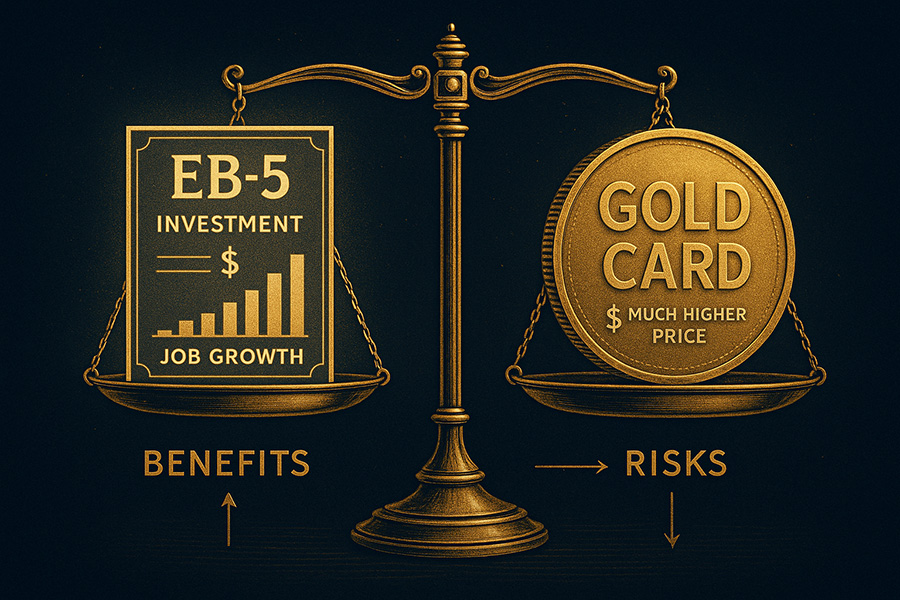
    EB-5 is a statute with fixed requirements: $800,000 in a targeted employment area or $1,050,000 elsewhere, capital genuinely at risk, and 10 full-time jobs per investor. The proposed Gold Card is a payment to the government with no job creation and no enacted law behind it. The practical difference is that EB-5 capital can come back and Gold Card money cannot.

    November 22, 20257 min read
    Read article
    How H-1B Visa Holders Can Obtain an EB-5 Visa and Green Card in 2026
    General

    How H-1B Visa Holders Can Obtain an EB-5 Visa and Green Card in 2026

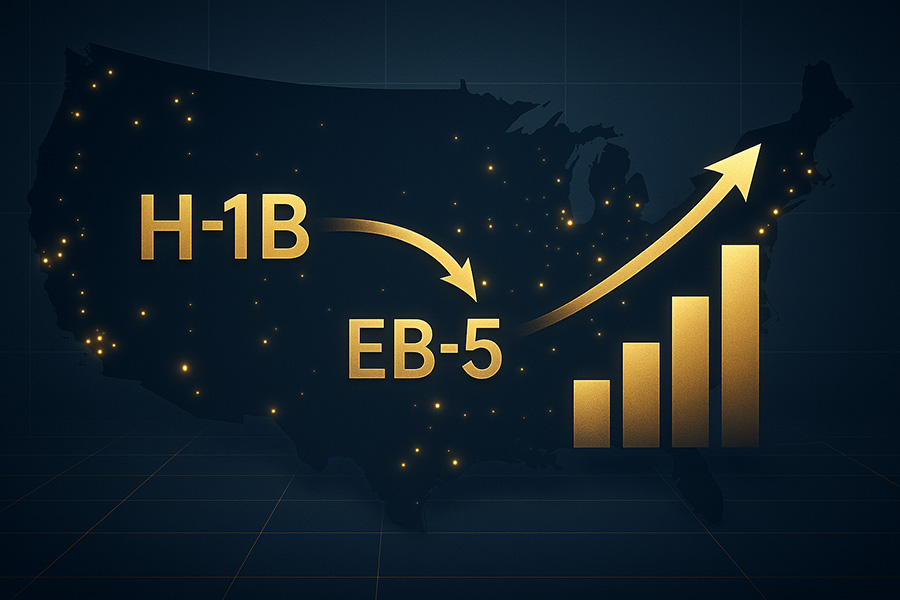
    H-1B holders qualify for EB-5 on the same terms as anyone else: $800,000 in a targeted employment area project or $1,050,000 outside one, lawfully sourced funds, and ten jobs created. The advantage of starting from H-1B is procedural, because H-1B is a dual intent visa and concurrent filing can produce an employer independent work permit while the case is pending. The catch is that concurrent filing requires a visa to be available in your category, which for Indian and Chinese applicants usually means a set-aside project.

    November 14, 20257 min read
    Read article