
🇺🇸English🇨🇳中文🇻🇳Tiếng Việt
EB-5 Legal Path
EB-5 US
HomeEB-5 WikiVisa BulletinCostRegional CentersGlossaryArticlesExpertsContact
Free Consultation - 24/7, Call +1 (920) 620-6969
Free Consultation - 24/7, Call +1 (920) 620-6969Call

EB-5 US

Independent EB-5 knowledge hub covering investment structures, compliance milestones, and attorney insight for families planning a residency by investment strategy.

EB-5 Projects & News

Resources

  • Visa Bulletin
  • Cost calculator
  • Regional centers
  • Glossary
  • Articles
  • Experts
  • HTML Sitemap

Company

  • Contact
  • Free Consultation - 24/7, Call +1 (920) 620-6969
  • +1 (920) 620-6969, Free Consultation - 24/7
  • No cost, no obligation
  • Email us

Legal

  • Disclaimer
  • Privacy Policy
  • Terms of Use
© 2026 EB-5 US. All rights reserved.
    1. Home
    2. Articles
    3. EB-5 vs. E-2 and L-1: Choosing the Right Investment Immigration Path, End of 2025
    Back to all articles

    EB-5 vs E-2 vs L-1 Visa: Which Investment Path Gets a Green Card

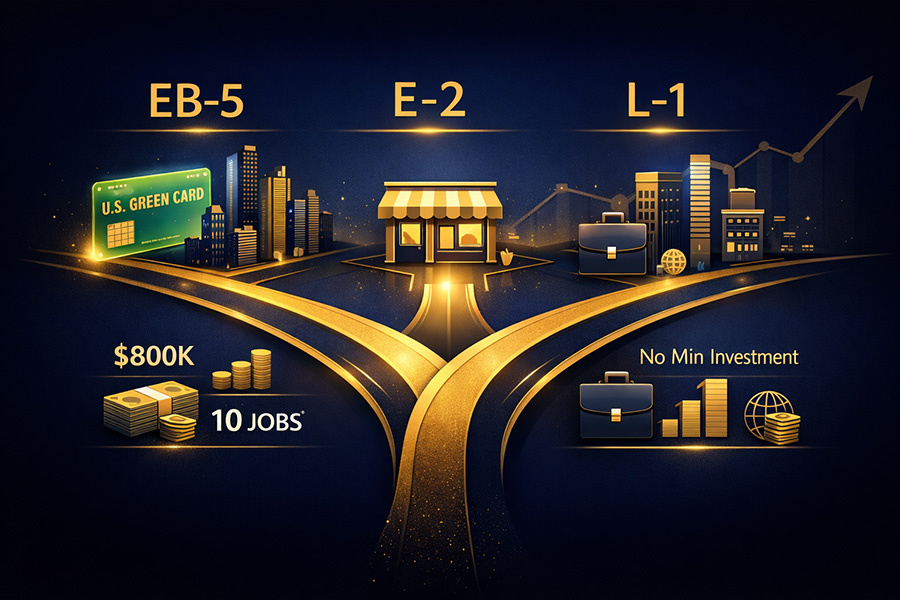
    EB-5 is the only one of the three that is an immigrant visa, so it is the only route that produces a green card on its own. E-2 renews forever without ever converting, and L-1 usually needs a separate EB-1C petition to reach permanent residence. The trade is capital against control: EB-5 costs $800,000 or $1,050,000 and lets you stay passive, E-2 costs less but requires you to run the business.

    Strategy
    December 29, 20257 min read
    Share LinkedIn Facebook Twitter (X) Copy link
    EB-5 vs. E-2 and L-1: Choosing the Right Investment Immigration Path, End of 2025

    On this page

    1. 1.What EB-5 Requires and What It Delivers
    2. 2.E-2: Quick to Enter, Permanently Temporary
    3. 3.L-1: A Transfer, Not an Investment
    4. 4.Nationality, Family and the Age 21 Problem
    5. 5.Capital at Risk Versus Capital You Control
    6. 6.How to Choose, By Situation
    7. 7.Sequencing More Than One Route
    8. 8.Related reading

    EB-5 is the only one of these three that is an immigrant visa, so it is the only one that produces a green card by itself. E-2 and L-1 are temporary. An E-2 can be renewed indefinitely and still leave you no closer to permanent residence, and an L-1 normally reaches a green card only through a separate EB-1C petition for multinational managers. The trade is capital against control. EB-5 costs $800,000 in a Targeted Employment Area or $1,050,000 outside one and lets you stay completely passive. E-2 can start with far less money but requires you to own and actually run the business. L-1 requires no personal investment at all, but it requires an employer that already exists abroad and is willing to move you.

    What EB-5 Requires and What It Delivers

    The mechanics live in 8 CFR 204.6, the EB-5 regulation, as reshaped by the EB-5 Reform and Integrity Act of 2022. You place capital into a new commercial enterprise, the capital stays genuinely at risk, and the project creates at least 10 full time jobs for qualifying US workers that are attributable to your investment. Full time means a position that requires at least 35 hours a week, and two separate part time roles added together do not make one.

    Most investors go through a regional center and file Form I-526E, the petition for a regional center investor. Investors who build their own company file Form I-526 instead and have to count and prove every job themselves. That difference matters more than people expect, and it is the reason a lot of buyers who describe themselves as entrepreneurs still choose a passive deal. The direct EB-5 route gives you control of the business and full exposure to its hiring performance at the same time.

    An approved petition does not hand you a green card by itself. You still go through consular processing or adjustment of status, and what you receive at the end is conditional permanent residence for you, your spouse and unmarried children under 21. That status lasts two years, and near the end of it you file Form I-829 to remove the conditions. Three dates belong on your calendar. The regional center program is authorized through 30 September 2027, petitions filed by 30 September 2026 carry grandfathering protection if authorization lapses, and the first inflation adjustment to the investment thresholds is due on 1 January 2027. The $800,000 figure has a shelf life.

    E-2: Quick to Enter, Permanently Temporary

    The E-2 treaty investor visa is open only to nationals of countries that hold a qualifying treaty of commerce and navigation with the United States. If your passport is not from a treaty country, the analysis ends there. Neither India nor mainland China is a treaty country, which explains a great deal about where EB-5 demand comes from.

    There is no statutory minimum for E-2. The tests are proportionality and marginality: the money must be substantial relative to the total cost of buying or establishing that particular business, and the business must generate more than a living for you and your family. A small consultancy with one laptop rarely clears the bar. A franchise with real premises, equipment and payroll usually does. You must own at least 50 percent or otherwise control the enterprise, and you must be there to direct and develop it. Passive money does not qualify for E-2, which is the mirror image of EB-5.

    Renewals are effectively unlimited as long as the business keeps trading, and E-2 spouses are treated as authorized to work. What E-2 never does is convert. There is no conditional residence at the end and no petition to remove conditions. If permanent residence is the goal, you change categories at some point, and a meaningful share of EB-5 investors are E-2 holders who reached that conclusion after five or ten years of renewals.

    L-1: A Transfer, Not an Investment

    L-1 moves an existing employee from a foreign company to a related US entity. You need at least one continuous year of employment with the qualifying foreign employer in the three years before the transfer, and the US role must be executive or managerial for L-1A or must involve specialized knowledge for L-1B. No personal capital is required.

    The catch is ownership of the status. The petition belongs to the employer, not to you. If the corporate relationship ends, so does your right to be in the country. L-1A allows a maximum of seven years and L-1B five. A newly opened US office is usually approved for one year first and has to show real hiring and revenue before it is extended, which is where a lot of thinly capitalized new office petitions come apart.

    L-1 is dual intent, so pursuing a green card does not damage the status. The natural permanent route for an L-1A manager is EB-1C, with no investment threshold and no job creation count, but with a genuine multinational structure and a managerial role that has to be managerial in substance rather than in job title. That comparison is worked through in detail in EB-5 vs L-1 and EB-1C 2026: Executive Transfer or Investor Path.

    Nationality, Family and the Age 21 Problem

    EB-5 accepts any nationality. Per country limits still create waiting lines for the highest demand countries, which is what the set-asides were built to relieve: 20 percent of annual EB-5 visas are reserved for rural projects, 10 percent for high unemployment areas and 2 percent for infrastructure.

    Children are where the three routes separate hardest. Derivative children on E-2 and L-2 status age out at 21 with nothing to fall back on except their own student or work visa. EB-5 derivatives are covered by the Child Status Protection Act, which can freeze a child's age for part of the processing period. If you have a 17 or 18 year old, that single difference often decides the whole strategy, and it is worth modelling before anything else. Spousal work rights exist on all three routes, so that is rarely the deciding factor.

    Capital at Risk Versus Capital You Control

    EB-5 money must stay genuinely at risk. No guaranteed return, no redemption right, no side letter promising repayment. In a regional center deal you are typically a limited partner earning a token rate of interest, with the real return being the green card, and you do not choose the contractor, the tenant or the exit. E-2 money is yours to direct and yours to lose. You are exposed to your own judgement rather than a sponsor's, plus the ordinary risk of running a small business in an unfamiliar market. Neither is safer in the abstract.

    Whichever way you go, the tax position starts before you arrive rather than after, and pre-immigration tax planning is far cheaper to do in advance than to unwind later, because permanent residence brings worldwide income reporting with it. Whether the EB-5 price makes sense at all for your circumstances is covered in our reality check on EB-5 risk, timeline and return.

    How to Choose, By Situation

    • You hold a passport from a non treaty country. E-2 is off the table. The real choice is EB-5 against an employment or talent based route.
    • You want permanent residence and you want to be passive. EB-5 through a regional center, with the set-aside categories worth a hard look because of visa availability.
    • You have $200,000 to $400,000 and you want to run a business. E-2 first, if your nationality allows it. Build the business, then reconsider EB-5 once the capital exists.
    • You already own or manage a company abroad with a US subsidiary. L-1A into EB-1C is usually cheaper than EB-5 and does not require putting $800,000 at risk.
    • You have a child close to 21. Weight EB-5 heavily. Nonimmigrant derivative status offers no protection against ageing out.

    Sequencing More Than One Route

    These categories are not exclusive. An E-2 holder can file an EB-5 petition without giving up E-2 status, and someone in the United States in valid status with a current priority date may be able to file an adjustment of status application instead of returning home for a consular interview. An L-1A manager can run an EB-1C petition and hold an EB-5 petition as a backup if the managerial evidence looks thin. Filing two petitions costs more in legal fees and nothing in eligibility, so combining immigration strategies deserves a conversation with counsel before you commit capital anywhere. For how long the EB-5 clock actually runs from first wire to naturalization, start with our EB-5 timeline breakdown. One honest caveat: processing times on all three routes move, sometimes sharply, and nobody can promise you a date. Build the plan so a twelve month slip does not break it.

    Related reading

    • EB-5 vs L-1 and EB-1C 2026: Executive Transfer or Investor Path
    • Is the EB-5 Visa Worth It? A 2026 Reality Check on Risk, Timeline, and ROI
    • Direct EB-5 Investment: Start Your Own US Business for a Green Card

    Sources

    This page is written from primary sources published by the United States government. Last updated August 3, 2026. It is general information about how the EB-5 programme works, not legal advice about your case.

    • 8 CFR 204.6, petitions for employment creation immigrants
    • Form I-526E, petition by a regional center investor
    • Form I-829, removing the conditions on residence
    • USCIS on adjustment of status

    Topics on this page: EB-5 Immigrant Investor Program, EB-5 Regional Center, EB-5 Reform and Integrity Act of 2022, Form I-526E.

    Key takeaways

    EB-5 is the only one of the three that is an immigrant visa, so it is the only route that produces a green card on its own. E-2 renews forever without ever converting, and L-1 usually needs a separate EB-1C petition to reach permanent resid

    Key topics

    EB-5 vs E-2L-1 comparisoninvestment visa differencesimmigrant vs nonimmigrantjob creationcorporate transfer

    From the EB-5 Wiki

    Reference entries covering the rules behind this story.

    • What If EB-5 Program Rules Change Mid-Process?

      Eligibility is judged against the rules in force when you properly filed, and the 2022 Reform and Integrity Act grandfathers petitions filed by 30 September 2026 even if the regional center program lapses. Fees, processing times, visa availability and USCIS policy interpretations are never locked. In practice, material change to your project is a far bigger threat than any new law.

    • From Blueprint to Reality: How EB-5 Helped Build Hudson Yards

      Hudson Yards used EB-5 capital, raised through a regional center the developer set up and controlled itself, as cheap subordinate financing during construction. The deal shows how job models and capital stack position really work, and why Congress rewrote the TEA rules in 2022. Both halves matter when you read an offering today.

    • Which is Safer: Regional Center or Direct EB-5?

      For most investors the Regional Center route carries lower immigration risk, because indirect and induced jobs are modeled by an economist before the money moves. Direct EB-5 removes the sponsor as a counterparty but puts all ten jobs on your own payroll. The safer choice depends on which of the two risks you are better equipped to carry.

    • I-829 Approval: Becoming a Permanent Resident Without Conditions

      I-829 approval converts conditional residence into ordinary lawful permanent residence and produces a green card valid for 10 years. The sustainment requirement on the $800,000 ends and the job creation question closes. Time spent in conditional status already counted toward the five years needed for naturalization.

    • Why Choose EB-5? Benefits of the Investor Green Card

      EB-5 is the one US green card route you can qualify for with capital rather than a job offer, an employer sponsor or a lottery win. A single investment of $800,000 in a Targeted Employment Area, or $1,050,000 outside one, covers the investor, spouse and unmarried children under 21. The trade offs are illiquidity, a two year conditional stage and no guaranteed return.

    • Preparing for I-829: Proving Job Creation and Sustained Investment

      The I-829 asks USCIS for two findings: that ten full time jobs for qualifying US workers exist because of your project, and that your capital stayed genuinely at risk for the required period. You file it in the 90 days before your second anniversary as a conditional resident, and the documents you attach are the entire case. Most failures come from records nobody kept, not from projects that failed.

    You may also like

    Editor-curated follow-ups saved to this article's list.

    • EB-5 in 2025: Record Demand, New Rules, and the Real Opportunities for Investors
    • EB-5 vs. Proposed Gold Card Scheme: Costs, Jobs & Investor Risks, Nov 2025
    • How H-1B Visa Holders Can Obtain an EB-5 Visa and Green Card in 2026
    • H-1B Anxiety Is Driving a Wave of Engineers Into EB-5, What This Means for the Program
    • Investment Visa Backlog, Fee Updates & Grandfathering Deadline, Nov 2025
    • Learning from EB-5 Project Failures: Warning Signs & Investor Protections, End of 2025
    • Redeployment Demystified: Keeping EB-5 Funds at Risk After Repayment, End of 2025
    • Return on Investment Beyond the Green Card: Direct vs. Indirect Gains, End of 2025
    • The Big Short, Margin Call and EB-5: What Crisis Movies Teach EB-5 Investors
    • Transforming Communities: Rural EB-5 Success Stories, Year-End 2025
    • Why Indian & Chinese Investors Shift to EB-5: Facts & Queue Impact

    Get EB-5 analysis

    Drop your email to get monthly briefings, attorney roundups, and due-diligence checklists.

    No spam. Unsubscribe any time.

    Investor FAQ

    Is EB-5 better than an E-2 visa?

    For permanent residence, yes. EB-5 is an immigrant visa that leads to a green card, while E-2 is a temporary status that renews indefinitely without ever becoming one. E-2 wins on cost and speed of entry, which is why some investors start there and file EB-5 later.

    Can I switch from an E-2 visa to EB-5?

    Yes. Nothing prevents an E-2 holder from filing an EB-5 petition, and many do once the capital is available. If you are in the United States in valid status with a current priority date, you may be able to adjust status rather than return home for a consular interview.

    Does the L-1 visa lead to a green card?

    Not by itself. L-1 is a temporary transfer capped at seven years for L-1A managers and five for L-1B specialists. The usual permanent route for an L-1A manager is a separate EB-1C petition, which needs a genuine multinational structure and a role that is managerial in substance.

    How much do you need to invest for an E-2 visa compared with EB-5?

    EB-5 has fixed thresholds: $800,000 in a Targeted Employment Area and $1,050,000 elsewhere. E-2 has no statutory minimum. The amount must simply be substantial relative to the cost of that particular business and enough that the enterprise is more than marginal.

    Related publications

    Hand-picked articles that cover similar categories and investor questions.

    How H-1B Visa Holders Can Obtain an EB-5 Visa and Green Card in 2026
    General

    How H-1B Visa Holders Can Obtain an EB-5 Visa and Green Card in 2026

    H-1B holders qualify for EB-5 on the same terms as anyone else: $800,000 in a targeted employment area project or $1,050,000 outside one, lawfully sourced funds, and ten jobs created. The advantage of starting from H-1B is procedural, because H-1B is a dual intent visa and concurrent filing can produce an employer independent work permit while the case is pending. The catch is that concurrent filing requires a visa to be available in your category, which for Indian and Chinese applicants usually means a set-aside project.

    November 14, 20257 min read
    Read article
    H-1B Anxiety Is Driving a Wave of Engineers Into EB-5, What This Means for the Program
    Trends

    H-1B Anxiety Is Driving a Wave of Engineers Into EB-5, What This Means for the Program

    H-1B holders are moving to EB-5 because it removes the lottery, the employer sponsorship and the country queue in EB-2 and EB-3. The cost is $800,000 in a Targeted Employment Area or $1,050,000 outside one, plus filing fees, an administrative fee and legal costs. Concurrent filing makes it workable from inside the US, but it carries a status trap worth understanding first.

    December 2, 20257 min read
    Read article