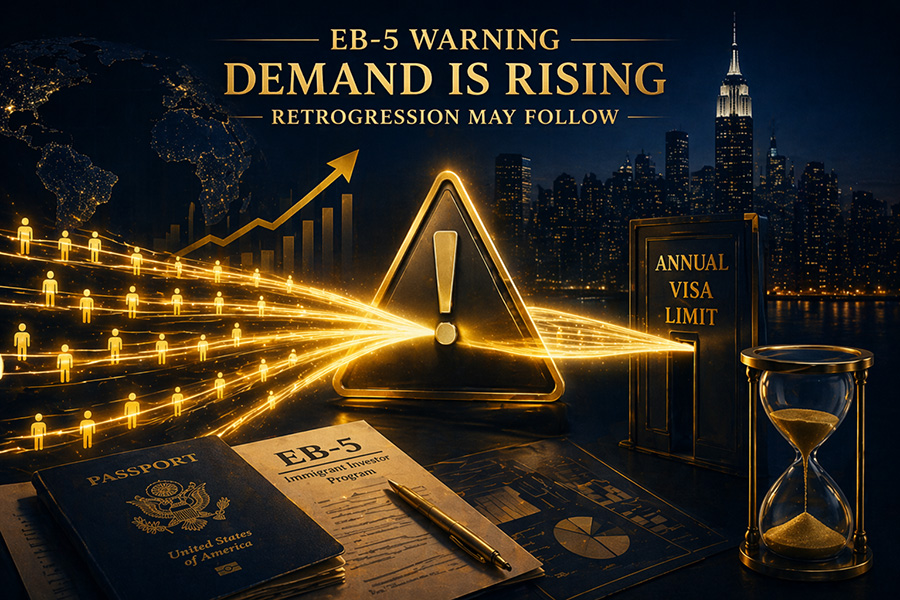
Rising demand is the real signal in a bulletin like the one issued for May 2026, and it matters because the charts report visa use rather than filings. A category can read current while pressure builds behind it. Check the live bulletin yourself before acting on any summary, this page included, since cut-off dates change monthly and a reference page cannot track them. Supply is fixed. Roughly 10,000 EB-5 numbers exist in a year with derivatives counted, so demand is the only variable that actually moves.
Two charts, and what each one is doing
Final Action Dates control when a visa can be issued abroad or an adjustment approved inside the United States. Dates for Filing control when an applicant may submit documents, and USCIS announces every month whether adjustment of status filers may use that more generous chart. Read both. Taking only one produces a distorted picture of where a category really stands, and that is the error repeated most often in the newsletters that summarize each bulletin for investors. Both charts sit in the State Department monthly Visa Bulletin.
Occasional narrative notes appear alongside the charts describing expected movement in coming months. Treat those as estimates from the Visa Office. They are not commitments, and they have been revised before.
Why a current category can still be under strain
A petition filed in one year does not consume a visa number in that year. The investor has to reach the front of the process first, either as a documentarily qualified applicant at the National Visa Center or through an approved petition with a pending adjustment application. That lag runs well beyond twelve months, which means the demand visible in any bulletin reflects decisions investors made a long time ago.
So a queue can be full and still look empty. Nothing in the charts corrects for that.
Reserved categories make this harder to read rather than easier. All three began empty in 2022. Rural takes 20 percent of the annual total. High unemployment takes 10 percent and infrastructure 2 percent. Unused numbers carry forward inside the same reserved category for a year before spilling into the unreserved pool, so the space that looks structural today may be nothing more than a starting balance being drawn down by filings nobody outside USCIS can count. Historical swings in EB-5 volume are documented in EB-5 Demand Trends: Record Years, Slowdowns and Processing Times.
Where the demand is coming from
Investors already living in the United States are the fastest moving segment. An H-1B or F-1 holder whose category is current can file Form I-485 concurrently with the petition, which compresses the distance between filing and visa consumption. A cohort that files together consumes numbers together, and the USCIS page on adjustment of status sets out the conditions for that route.
India is the clearest example of the pattern, with demand arriving from professionals already inside the immigration system who are tired of waiting in EB-2 or EB-3. A household that has already spent eight years attached to an employment based petition tends to treat $800,000 as the price of ending the wait rather than as a portfolio decision, and that is exactly the mindset that fills a small set-aside queue in a hurry. Demand shaped like that moves fast. Our page on EB-5 Demand in India: Backlog Risk, Set-Aside Queues and Filing Costs works through the numbers behind it.
Vietnam has run hot relative to its 7 percent share for years, which is why category choice there is a live strategic question rather than a formality. Hong Kong is its own chargeability area rather than part of mainland China, so a Hong Kong born applicant reads the general column of the bulletin and not the China mainland born one, a distinction worth confirming before you assume a regional queue applies to you. Both situations are covered in EB-5 Visa Category Choice in Vietnam: Backlog Risk and Filing Timing and in EB-5 from Hong Kong: Separate Visa Queue and Surging Demand.
Countries with no queue of their own still matter to the arithmetic, because their investors draw from the same annual pool.
The 30 September 2026 clock runs separately
Visa queue pressure and program authorization are two different risks, and conflating them pushes people to rush for the wrong reason. Regional Center authorization runs to 30 September 2027. Petitions filed on or before 30 September 2026 are protected under 8 U.S.C. 1153(b)(5)(S), titled Protection from expired legislation, so they continue to be processed even if the program lapses later. That protection is worth having.
A third date belongs on the same calendar. On 1 January 2027 the first inflation adjustment lifts the $800,000 and $1,050,000 thresholds, which changes the price rather than the queue. What happens after the 2027 sunset is examined in EB-5 September 2026 Deadline and the 2027 Regional Center Sunset.
Steps that reduce your exposure
Confirm the Regional Center has filed Form I-956F for the exact offering you are joining. Filing of the I-956F is what permits your Form I-526E to be filed, while approval of it is required before your petition can be approved. Sponsors sometimes blur those two. An investor who waits for approval before filing surrenders priority date for no reason at all.
Establish your country of chargeability early. A spouse born in a different country can allow cross chargeability, which occasionally converts a decade of waiting into none. The check costs nothing.
Assemble source of funds documentation before choosing a project, because tracing capital across jurisdictions is usually the slowest part of the whole exercise. Then look at current adjudication times in the USCIS processing times tool and country by country consumption in the State Department immigrant visa statistics.
Do not let urgency shorten diligence on the offering itself. Deadline pressure is exactly the environment in which weak deals get sold, and the warning signs are listed in EB-5 Red Flags: Warning Signs to Check Before You Wire $800,000.
What this reading cannot tell you
Nobody outside the Visa Office knows the pending demand figures in real time, and public data arrives late and incomplete. Anyone claiming to know the month a category will retrogress is guessing, whatever confidence they attach to the guess. Ask what evidence sits behind such a claim, and watch how often the honest answer turns out to be a sales calendar rather than a data source.
Congress could also change the arithmetic. Additional visa numbers or an exemption for derivative family members would each reset the picture, and neither is probable enough to plan around. Work from the rules as they stand. Revisit the bulletin every month.
Related reading
Sources
This page is written from primary sources published by the United States government. Last updated August 5, 2026. It is general information about how the EB-5 programme works, not legal advice about your case.
- State Department, the Visa Bulletin
- USCIS on adjustment of status
- USCIS processing times
- State Department visa statistics
Topics on this page: EB-5 Immigrant Investor Program, EB-5 Regional Center, EB-5 Reform and Integrity Act of 2022, Form I-526E.