

🇺🇸English🇨🇳中文🇻🇳Tiếng Việt
EB-5 Legal Path
EB-5 US
HomeEB-5 WikiVisa BulletinCostRegional CentersGlossaryArticlesExpertsContact
Free Consultation - 24/7, Call +1 (920) 620-6969
Free Consultation - 24/7, Call +1 (920) 620-6969Call

EB-5 US

Independent EB-5 knowledge hub covering investment structures, compliance milestones, and attorney insight for families planning a residency by investment strategy.

EB-5 Projects & News

Resources

  • Visa Bulletin
  • Cost calculator
  • Regional centers
  • Glossary
  • Articles
  • Experts
  • HTML Sitemap

Company

  • Contact
  • Free Consultation - 24/7, Call +1 (920) 620-6969
  • +1 (920) 620-6969, Free Consultation - 24/7
  • No cost, no obligation
  • Email us

Legal

  • Disclaimer
  • Privacy Policy
  • Terms of Use
© 2026 EB-5 US. All rights reserved.
    1. Home
    2. Articles
    3. EB-5 Visa Bulletin 2026 Anomaly: Why Dates Jumped and May Reverse
    Back to all articles

    EB-5 Visa Bulletin 2026 Anomaly: Why Dates Jumped and May Reverse

    EB-5 cut off dates advanced in 2026 because visa numbers had to be used within the fiscal year, not because the queue got shorter. Aggressive forward movement usually pulls in a wave of new demand, and retrogression follows. Filing locks in a priority date, the current investment amounts and the grandfathering deadline, so the window matters more than the headline.

    Visa Bulletin
    April 1, 20266 min read
    Share LinkedIn Facebook Twitter (X) Copy link
    EB-5 Visa Bulletin 2026 Anomaly: Why Dates Jumped and May Reverse

    On this page

    1. 1.What the Visa Bulletin Is Actually Measuring
    2. 2.Why Dates Moved Forward
    3. 3.Why a Reversal Is the Base Case
    4. 4.Reserved and Unreserved Are Two Different Markets
    5. 5.What Filing Now Actually Locks In
    6. 6.What Not to Conclude From a Favorable Bulletin
    7. 7.Related reading

    The forward movement in the 2026 EB-5 visa bulletins reflects visa supply timing, not a shrinking queue. Dates advanced because numbers were available to be used inside the fiscal year, and the Department of State moves cut off dates forward to make sure the annual allocation is not wasted. Nothing about that movement means fewer people are waiting ahead of you. When demand catches up with the numbers being released, cut off dates move backward again, and that reversal, called retrogression, is normal rather than exceptional. Treat the current window as an opportunity with an expiry date, not as evidence that the backlog is clearing.

    What the Visa Bulletin Is Actually Measuring

    The bulletin is a rationing device. Each employment based preference category, EB-5 included, receives a fixed annual allocation under the statute, and each country of chargeability is capped at a share of that total. The allocation rules sit in section 1153 of title 8 of the United States Code. When more people want visas in a category than there are numbers available, the Department of State publishes a cut off date, and only applicants whose priority date falls earlier than that cut off may move ahead.

    Your priority date is the date your I-526E petition was properly filed. It is your place in line and it does not change. Two charts govern what you can do with it. Final Action Dates control when a visa can actually be issued or a green card approved. Dates for Filing control when you may submit the next stage of paperwork, and USCIS announces each month whether adjustment applicants may use the more generous chart. Confusing the two is the most common reading error, and our guide to reading the EB-5 visa bulletin and priority dates works through it line by line.

    Why Dates Moved Forward

    Three mechanical forces push cut off dates forward, and none of them is a reduction in demand.

    • Numbers must be used or lost. The fiscal year runs from October to September. Employment based numbers do not accumulate indefinitely, so the Department of State advances dates to pull enough qualified applicants into the pipeline to consume the annual supply before it expires.
    • Demand data lags. Cut offs are set from documentarily qualified cases at the National Visa Center and pending adjustment applications at USCIS. Petitions that have been filed but not yet approved are largely invisible in that count. A large pending inventory therefore does not restrain forward movement until it converts.
    • Reallocation across categories. Numbers that one category or one country cannot use flow elsewhere under the statutory formulas. A surge in supply from that mechanism looks identical, from the outside, to genuine demand relief.

    Put together, aggressive forward movement is often a sign that the system is trying to pull applicants forward quickly, which is closer to a warning than to a reassurance. The mechanics of rollovers and unused numbers are explained in our page on EB-5 visa allocation, unused numbers and reserves.

    Why a Reversal Is the Base Case

    Retrogression follows aggressive advancement for a straightforward reason. When dates jump, a large group of applicants becomes eligible all at once. They file, they qualify documentarily, and within a few months the visible demand in that category rises sharply. The Department of State then has to pull the cut off back to stay inside the annual limit, sometimes by more than it advanced. This pattern has repeated across employment based categories for years, and there is no structural reason EB-5 is exempt from it.

    For EB-5 specifically, two further pressures point the same way. Petition volume since the Reform and Integrity Act has been substantial, and much of it has not yet converted into visa usage. And the reserved categories, which began life current for every country, absorb new filings continuously. Current is not a permanent state. It is simply the condition of a queue that has not filled yet. Our page on EB-5 backlogs and retrogression covers how the queue behaves once it does.

    Reserved and Unreserved Are Two Different Markets

    The Reform and Integrity Act split EB-5 into set aside pools: 20 percent of the annual allocation for rural projects, 10 percent for high unemployment areas, and 2 percent for infrastructure, with the remainder unreserved. Each pool has its own supply, its own demand and its own cut off dates. Unused set aside numbers carry forward within the same category the following year before spilling into the unreserved pool.

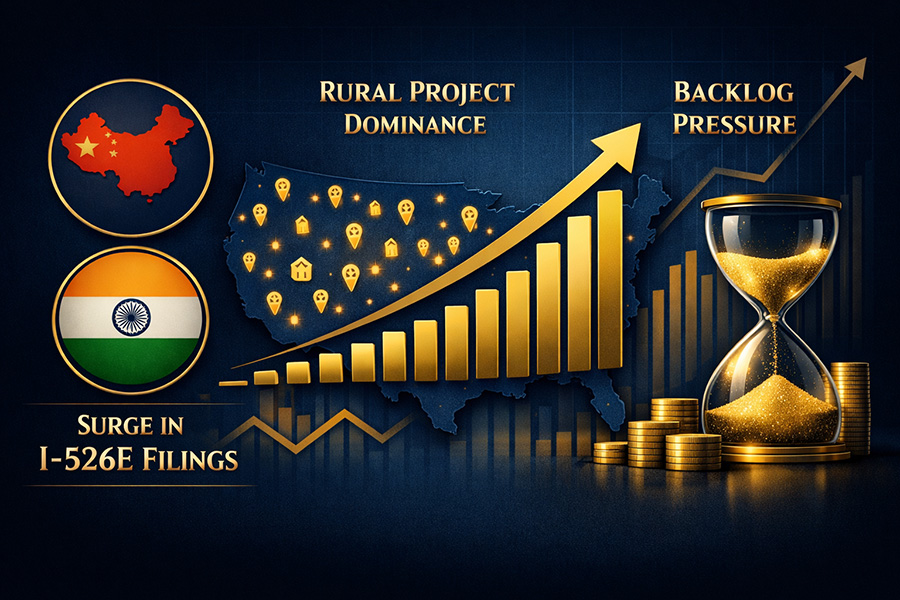
    The consequence is that a headline about EB-5 dates moving means very little unless it says which pool. Unreserved EB-5 carries the accumulated backlog, and applicants chargeable to mainland China and increasingly to India hit the per country ceiling there first. The reserved pools are far smaller in absolute terms but carry much less accumulated demand, which is why rural and high unemployment projects have dominated new filings. That advantage is a function of timing, and it erodes as filings accumulate.

    What Filing Now Actually Locks In

    Filing does not lock in a wait time. It locks in three specific things, and it is worth being precise about them.

    • Your place in the queue. The priority date attaches when the Form I-526E petition is properly filed, and it survives retrogression. If dates retrogress past you, you wait; you do not lose your position.
    • The investment amount that applies to your petition. The required amounts are $800,000 in a targeted employment area and $1,050,000 outside one. The first statutory inflation adjustment takes effect on 1 January 2027, so petitions filed before that date are assessed against the current figures.
    • Grandfathering against a program lapse. The regional center program is authorized through 30 September 2027, and a petition filed by 30 September 2026 continues to be processed even if the program lapses afterwards. That deadline is fixed and does not move with the bulletin.

    If a visa number is available in your category when you file and you are in the United States in valid status, you can also file the green card application at the same time as the petition, which is where an open window turns into work and travel authorization years ahead of the green card itself. The mechanics are in our guide to concurrent filing of the I-526E and I-485, and USCIS sets out the underlying rules on its adjustment of status page. The eligibility standards applied to the petition itself are published in the EB-5 chapter of the USCIS Policy Manual.

    What Not to Conclude From a Favorable Bulletin

    Do not conclude that the backlog is shrinking, because the bulletin does not measure the backlog. Do not conclude that a category which is current will stay current, because every backlogged category was current once. Do not delay filing to see whether dates improve further, because the risk is asymmetric: filing early costs you nothing if dates keep advancing, while waiting costs you the priority date if they reverse. And do not let a favorable chart drive your project selection. A project chosen for its set aside category rather than for its ability to build and to create the ten jobs per investor is a bad investment with a good queue position, which is the worst combination this program offers.

    Families with children close to twenty one should treat any open window with particular urgency, since a retrogression that lands before the child's age is locked can cost the family a dependent. The calculation is set out on our page covering the Child Status Protection Act in EB-5.

    Related reading

    • EB-5 Visa Bulletin Explained: How to Read Priority Dates and Cut-Offs
    • EB-5 Backlogs 2026: Retrogression, Country Limits and How to Shorten Your Wait
    • EB-5 Visa Allocation 2026: Unused Numbers and Your Place in Line

    Sources

    This page is written from primary sources published by the United States government. Last updated August 5, 2026. It is general information about how the EB-5 programme works, not legal advice about your case.

    • 8 U.S.C. 1153, how immigrant visas are allocated
    • Form I-526E, petition by a regional center investor
    • USCIS on adjustment of status
    • USCIS Policy Manual, Volume 6 Part G on EB-5

    Topics on this page: EB-5 Immigrant Investor Program, Targeted Employment Area, EB-5 Regional Center, EB-5 Reform and Integrity Act of 2022.

    Key takeaways

    EB-5 cut off dates advanced in 2026 because visa numbers had to be used within the fiscal year, not because the queue got shorter. Aggressive forward movement usually pulls in a wave of new demand, and retrogression follows. Filing locks in

    Key topics

    EB-5Visa BulletinPriority DatesRetrogression RiskReserved EB-5Unreserved EB-5

    From the EB-5 Wiki

    Reference entries covering the rules behind this story.

    • Backlogs and Retrogression: The EB-5 Visa Queue Explained

      Retrogression means the State Department moved a cut-off date backward, so applicants who were eligible to proceed must wait again. In EB-5 it is driven by the 7 percent per country limit meeting heavy demand from India and mainland China. The rural, high unemployment and infrastructure set asides created by the 2022 reform law have their own separate rows and can cut years from the wait.

    • EB-5 Demand in India: Current Status and Future Outlook

      Indian EB-5 filings rank among the highest in the program because the EB-2 and EB-3 queues for India run for decades while the reserved rural and high unemployment categories have stayed available. A cut-off date already applies to India in the unreserved category, so the priority date locked at filing is what protects a family. Costs beyond the $800,000 include the petition fee, the $1,000 Integrity Fund fee and a regional center administrative charge.

    • EB-5 for Chinese Investors: Navigating Long Wait Times

      Mainland China born EB-5 investors face two separate queues. The unreserved pool holds 68 percent of visas and the entire historic backlog, while the rural and high unemployment set-asides created in 2022 began from zero demand and move far faster. Choosing between them is the decision that determines the wait.

    • Hong Kong vs Mainland: EB-5 Quota Differences and Opportunities

      Hong Kong born EB-5 investors are charged to a different visa queue from mainland China born investors, because chargeability follows place of birth. Their category has generally been current, so the timeline depends on USCIS adjudication rather than a cut-off date. A mainland born investor married to a Hong Kong born spouse can often cross charge into the shorter queue.

    • Concurrent Filing of I-526 and I-485 (Adjustment) Explained

      Concurrent filing puts your I-485 in the same package as your EB-5 petition, so work and travel permission arrives years before the green card does. It requires two things on the day you file: physical presence in the US in a status that permits adjustment, and an available visa number under the Visa Bulletin. Investors abroad, and anyone out of status, use consular processing instead.

    • Child Status Protection Act (CSPA) in EB-5: Protecting Kids from Aging Out

      CSPA age equals a child's real age when an EB-5 visa first becomes available, minus the days the I-526E or I-526 was pending at USCIS. Backlog waiting time is not deducted, which is where nearly all the wait sits for India and China. The child must also seek permanent residence within one year of visa availability.

    You may also like

    Editor-curated follow-ups saved to this article's list.

    • 2026 EB-5 Outlook: Lower Fees, Stable Set-Asides & Growing Compliance Pressure
    • 25 Mistakes That Cause EB-5 Cases to Fail in 2026
    • Concurrent Filing in 2026: A Fast Track to EAD, AP and Priority Date Lock
    • EB-5 in 2025: Record Demand, New Rules, and the Real Opportunities for Investors
    • EB-5 in South America: Why 2026 Demand Is Rising Fast
    • EB-5 Consular Interview: Why the Most Risk Begins After I-526E Approval
    • EB-5 vs. E-2 and L-1: Choosing the Right Investment Immigration Path, End of 2025
    • EB-5 vs. Proposed Gold Card Scheme: Costs, Jobs & Investor Risks, Nov 2025
    • Early 2026 I-526E Processing Data: Surging Filings and Backlog Risks
    • How H-1B Visa Holders Can Obtain an EB-5 Visa and Green Card in 2026
    • How USCIS’s “Anti-American Activity” Policy and Social Media Checks Could Impact Your EB-5 Case
    • H-1B Anxiety Is Driving a Wave of Engineers Into EB-5, What This Means for the Program
    • Investment Visa Backlog, Fee Updates & Grandfathering Deadline, Nov 2025
    • Labor Market Shifts & EB-5 Investments: Aligning with America’s Workforce Needs
    • Learning from EB-5 Project Failures: Warning Signs & Investor Protections, End of 2025
    • March 2026 Visa Bulletin: Understanding the 40-Day Advance for China’s Unreserved EB-5 Category
    • New Court Ruling Eases EB-5 Source-of-Funds Tracing: What’s Required in 2026
    • Partial EB-5: Splitting Your Investment to Secure a Priority Date

    Get EB-5 analysis

    Drop your email to get monthly briefings, attorney roundups, and due-diligence checklists.

    No spam. Unsubscribe any time.

    Investor FAQ

    Why did EB-5 priority dates move forward in 2026?

    Because visa numbers were available and had to be used within the fiscal year. The Department of State advances cut off dates to draw enough qualified applicants into the pipeline to consume the annual allocation. That is a supply timing effect, not a sign that fewer people are waiting.

    Can the EB-5 visa bulletin retrogress after dates move forward?

    Yes, and it commonly does. A large forward jump makes many applicants eligible at once, visible demand rises within months, and the cut off is pulled back to stay inside the annual limit. Your priority date is not lost when that happens, but your wait gets longer.

    What is the difference between reserved and unreserved EB-5 visas?

    The Reform and Integrity Act set aside 20 percent of annual EB-5 visas for rural projects, 10 percent for high unemployment areas and 2 percent for infrastructure. Each set aside has its own supply and its own cut off dates, and unused numbers carry forward within the same category before spilling into the unreserved pool.

    Does filing my I-526E now lock in the $800,000 investment amount?

    The amount that applies is the one in effect when you file, so a petition filed before the first inflation adjustment on 1 January 2027 is assessed against the current $800,000 targeted employment area figure or $1,050,000 outside one. Filing by 30 September 2026 also secures grandfathering against a program lapse.

    Related publications

    Hand-picked articles that cover similar categories and investor questions.

    Early 2026 I-526E Processing Data: Surging Filings and Backlog Risks
    Analysis

    Early 2026 I-526E Processing Data: Surging Filings and Backlog Risks

    New I-526E filings are rising faster than USCIS is deciding cases, and most of the new volume is going into the rural set-aside. The 30 September 2026 grandfathering deadline is the main driver, and the per country limit means Indian and Chinese demand can hit cut-off dates inside the set-asides before anyone else does. Filing early to lock a priority date matters more than any project marketing claim.

    February 9, 20266 min read
    Read article
    March 2026 Visa Bulletin: Understanding the 40-Day Advance for China’s Unreserved EB-5 Category
    Visa Bulletin

    March 2026 Visa Bulletin: Understanding the 40-Day Advance for China’s Unreserved EB-5 Category

    The March 2026 Visa Bulletin moved the Dates for Filing cut-off for mainland China in the unreserved EB-5 category from 22 August 2016 to 1 October 2016, an advance of 40 days. It lets a narrow group of pre-2022 Chinese investors start document work or file for adjustment of status. It says nothing useful about how fast the rest of the China line will move.

    March 13, 20266 min read
    Read article