
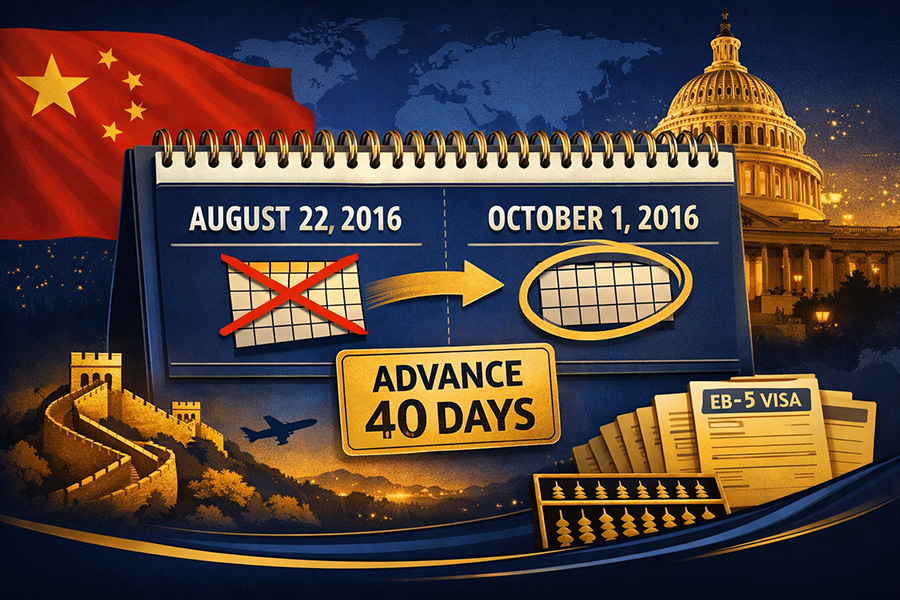
The March 2026 Visa Bulletin moved the Dates for Filing cut-off for mainland China in the unreserved EB-5 category forward by 40 days, from 22 August 2016 to 1 October 2016. In practice that means Chinese investors holding a priority date earlier than 1 October 2016 can now be invited to submit civil documents to the National Visa Center, or, in months when the adjustment chart in use allows it, file Form I-485 inside the United States. It is a genuine step forward for a narrow group of pre-2022 investors. It changes nothing for anyone who invested after 2016, and it is not evidence that the China queue is about to clear.
What the unreserved category is
EB-5 receives 7.1 percent of the worldwide employment based immigrant visa supply each year. The EB-5 Reform and Integrity Act of 2022 split that supply into two very different queues. Twenty percent of the annual EB-5 numbers are reserved for rural projects, 10 percent for projects in areas of high unemployment, and 2 percent for qualifying infrastructure projects. The remaining 68 percent is the unreserved category.
Unreserved is the ordinary, general EB-5 line. It is also where the entire pre-2022 Chinese backlog sits, because every one of those petitions was filed before set-asides existed. When people say the China EB-5 wait is measured in years, they mean the unreserved line. The statutory framework for all of this sits in 8 U.S.C. 1153, the allocation of employment based immigrant visas, and the operating detail is in the USCIS Policy Manual chapter on immigrant investors.
The two queues do not feed each other on a monthly basis. A Chinese investor who files a rural set-aside petition today is not standing behind a 2016 priority date, because rural visas come from a separate pot. That design choice is the single biggest reason investors from backlogged countries have gravitated to set-aside projects since 2022. If the mechanics are new to you, start with Visa Set-Asides (Rural, Urban, Infrastructure): How They Work.
What a 40 day advance actually unlocks
The Visa Bulletin publishes two charts, and they do different jobs. Dates for Filing tells you when you may assemble and submit an application. Final Action Dates tells you when an immigrant visa number can actually be issued and the green card granted. The March advance was on the filing chart. Nobody gets a visa because of it. What they get is permission to begin.
For an investor abroad, that means the National Visa Center can request fees, the DS-260 and supporting civil documents, and the case can move toward an interview slot. The process is described on the USCIS page on consular processing. For an investor already in the United States in another lawful status, and only in months when USCIS accepts the Dates for Filing chart, it means Form I-485, the application to register permanent residence can be filed, with work and travel authorization requested alongside it. That second point is the one that changes daily life, and it is covered in more depth in Concurrent Filing of I-526 and I-485 (Adjustment) Explained and on the USCIS adjustment of status overview.
Check which chart USCIS is following for the month before you file. The agency announces it separately from the State Department bulletin, and it does not always follow the filing chart.
Why cut-off dates move at all
The State Department sets each month's cut-off by estimating how much documentarily qualified demand sits at or before a given priority date, then comparing that to the numbers it expects to have available. When the demand it can see is smaller than the supply it must use, it advances the date to pull more cases forward. When demand turns out larger than modeled, the date stalls or retrogresses.
Be skeptical of confident explanations for any single month's movement. The bulletin rarely publishes the underlying demand data, so most commentary about why a date jumped is inference. What can be said honestly is that several ordinary things reduce visible demand at old priority dates: petitions get denied or abandoned, investors die or give up, families turn out smaller than modeled, and some cases sit unresponsive at the National Visa Center for years. Each investor typically consumes more than one visa number, because spouses and children count against the cap, so small errors in family size estimates move dates.
One structural point is worth understanding. Under the 2022 statute, reserved visas that go unused in a fiscal year carry forward inside the reserved categories before they ever spill into the unreserved pool. A quiet year for rural set-asides does not translate into a windfall for the 2016 China line the following month. For the wider mechanics of queue movement, see Backlogs and Retrogression: The EB-5 Visa Queue Explained.
What to do this month if your date is now current for filing
Move, but move in order. Confirm your priority date from the receipt notice rather than from memory, then confirm which chart applies to your filing route. Pull civil documents that take months to obtain in China, including police certificates and notarized birth records, before you need them, and time medical examinations so they do not expire.
Two traps matter more than the rest. First, children. If a child is close to 21, the Child Status Protection Act calculation can decide whether the family immigrates together, and it interacts with when the date became current. Read Child Status Protection Act (CSPA) in EB-5: Protecting Kids from Aging Out and get it checked by counsel, not by a forum post. Second, your capital. A 2016 priority date means your money has been deployed for the better part of a decade, and your project may have repaid the loan and redeployed. Sustainment rules still apply to your case. Redeployment of EB-5 Capital: Keeping Funds At Risk During Delays explains what your fund manager should be able to show you.
What not to read into a single bulletin
Forty days on a queue measured in years is not a trend. Dates for Filing can retrogress, and China has seen it happen before in other categories. Any plan that only works if the date keeps moving at this speed is not a plan.
The bad advice circulating after every favorable bulletin is the same: file something quickly to lock in a place. Filing an application you are not documentarily ready to support does not protect you. It creates a request for evidence, and in the worst cases a denial that is far harder to unwind than a short wait. Speed helps only when the file behind it is complete.
If you are a new Chinese investor, this is not your bulletin
Anyone investing now is choosing between the unreserved line, which for China is still the 2016 era queue, and the rural or high unemployment set-asides, which have been current or close to current for all countries. The difference is measured in years of your life, not in filing fees. That is a project selection decision as much as an immigration one, since a set-aside allocation depends entirely on where the project sits and how it qualifies. Investors weighing that trade-off should read EB-5 for Chinese Investors: Navigating Long Wait Times before shortlisting projects, and should confirm the set-aside claim in the offering documents rather than in the marketing deck. Form I-526E, the petition for regional center investors, is where that claim gets tested.
Watch the bulletin monthly, plan on the assumption that dates can move both ways, and keep the documentation current so that when a window opens you are ready inside the same month it appears.
Related reading
Sources
This page is written from primary sources published by the United States government. Last updated August 3, 2026. It is general information about how the EB-5 programme works, not legal advice about your case.
- 8 U.S.C. 1153, how immigrant visas are allocated
- USCIS Policy Manual, Volume 6 Part G on EB-5
- USCIS on consular processing
- Form I-485, adjustment of status
- USCIS on adjustment of status
- Form I-526E, petition by a regional center investor
Topics on this page: EB-5 Immigrant Investor Program, EB-5 Regional Center, EB-5 Reform and Integrity Act of 2022, Form I-526E.