
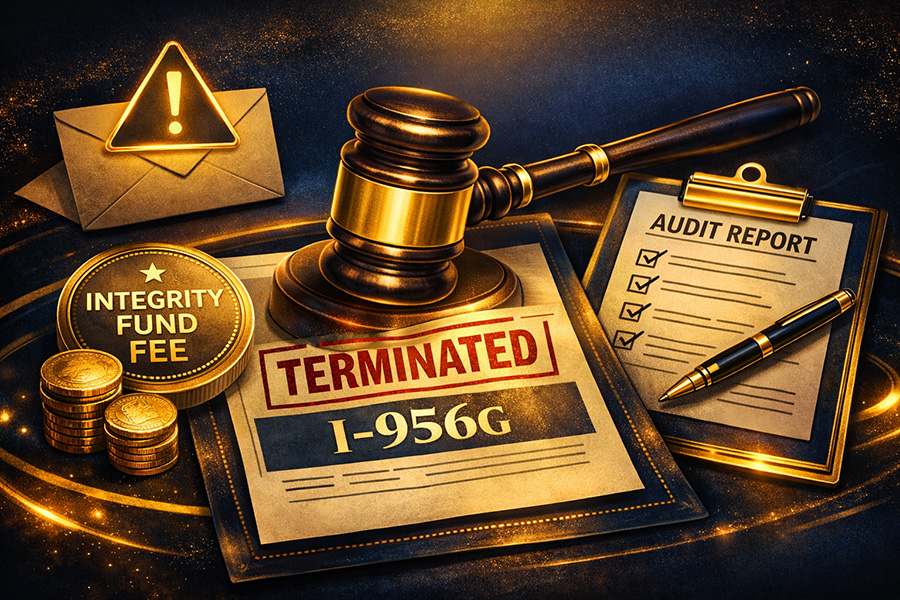
USCIS terminates EB-5 regional centers for three failures above all others, and none of them are about whether the underlying project is any good. The annual EB-5 Integrity Fund fee was not paid. The annual Form I-956G statement was not filed, or arrived with sections left blank. The center ignored, stonewalled or obstructed an audit. Each is an independent ground for termination under the EB-5 Reform and Integrity Act of 2022, and each is trivial for the agency to prove, because a missing payment and a missing document are facts rather than judgement calls. If your center is terminated, your petition is not automatically dead, but a short statutory window opens and you have to use it.
The Three Grounds Behind Most Terminations
- Unpaid Integrity Fund fee. Every designated regional center owes an annual fee into the EB-5 Integrity Fund. Non payment is the cleanest termination ground in the statute and the one that catches dormant centers that stopped raising capital but never formally wound down.
- Missing or incomplete Form I-956G. The annual statement is the agency's proof that a center still qualifies. Filing the obsolete I-924A, skipping the job creation tables or leaving the securities compliance certification unsigned is treated as a failure to file.
- Non cooperation with an audit. The Reform and Integrity Act gave USCIS an audit mandate with teeth. Refusing records, missing response deadlines or blocking a site visit is itself grounds for termination, independent of what the records would have shown.
The Integrity Fund Fee Is Statutory, Not an Invoice
The fee is set by statute in the full text of the EB-5 Reform and Integrity Act of 2022 at $20,000 per regional center per year, reduced to $10,000 for a center with 20 or fewer total investors in the preceding fiscal year. It is due annually, and USCIS publishes the payment window each cycle.
Treat it as a solvency signal. A regional center holding investor capital that cannot find $20,000 for a mandatory federal fee is telling you something about its balance sheet that no marketing deck will. The money is not symbolic either: the Integrity Fund is what pays for the audits, the site visits and the investigations that the same statute requires. Centers that skip the fee are, in a very direct sense, refusing to fund their own supervision.
Form I-956G Is Where Centers Get Caught
Form I-956G, the regional center annual statement, replaced the old I-924A and asks for considerably more. Capital raised and deployed, aggregate job creation, the identity and role of the fund administrator, details of each associated new commercial enterprise, and a certification about compliance with securities laws. It covers the federal fiscal year and is due within a short statutory window after that year closes, which puts the practical deadline at the end of December.
The pattern in termination notices is boring and repeatable. A center files late. A center files the wrong form. A center files on time but leaves the job creation methodology or the fund administration section empty because the answer was inconvenient. USCIS issues a notice of intent to terminate, the center misses the response deadline as well, and the designation is gone. Very little of this involves fraud. Most of it involves a small operation that never staffed a compliance function. Our page on post-RIA compliance and oversight rules walks through what a properly run center actually has to maintain.
Audits Are No Longer Rare
The statute requires USCIS to audit each regional center on a recurring cycle, at least once every five years. That changed the culture. Audits used to be an exception reserved for centers already under suspicion. Now a center with a clean record will still be audited eventually, and many are going through it for the first time.
Auditors ask for bank statements, fund administrator reports, subscription documents, developer and construction contracts, payroll evidence supporting job claims, and the economic reports underpinning the job models. They interview staff and they visit sites. Response deadlines are short, measured in days rather than months. A center that cannot produce a coherent audit file within that window is in trouble whether or not anything improper happened. What USCIS looks for is set out in the USCIS Policy Manual chapter on immigrant investors, and the practical mechanics are covered in our guide to surviving post RIA regional center audits.
What a Termination Does to Your Petition
Termination of the center does not by itself revoke an approved investor petition, and it does not automatically deny a pending one. It does break the link that made the petition a regional center case, which matters because regional center investors rely on indirect and induced job counting that direct investors cannot use. USCIS notifies affected investors, and that notice starts the clock.
Two situations feel very different in practice. If your I-526E is still pending, you are in the more awkward position, because the project approval under Form I-956F, the regional center project application, was the foundation of your filing. If your petition is already approved and you hold conditional residence, the question shifts to whether the enterprise will still support the job evidence you need at the I-829 stage.
The 180 Day Window and What Good Faith Buys You
The Reform and Integrity Act built protections for investors who did nothing wrong. When a regional center is terminated, an investor who invested in good faith generally has 180 days from the notice to take corrective action. In broad terms that means showing the new commercial enterprise still satisfies EB-5 requirements without the terminated center, or associating the investment with another approved regional center, and in either case preserving the original priority date.
Be honest about the limits. The good faith protections are relatively new, the operational guidance has moved more than once, and the outcome in a given case can turn on facts specific to the project documents. Anyone who tells you the answer is automatic is guessing. What is not in doubt is the timing: 180 days is short, and the opening weeks usually disappear into confusion. If a notice lands, engage an immigration attorney and a securities lawyer in the same week, and read the offering documents to see whether the sponsor has any obligation to fund a remedy.
If what you find looks less like negligence and more like misuse of funds, the agency operates a channel to report immigration fraud and misconduct, and reporting does not waive your civil remedies.
Questions to Ask Before You Wire Money
- Show me proof the Integrity Fund fee was paid for each of the last three years.
- Show me the filed I-956G for the last two fiscal years, complete, not a summary.
- Has this center been audited, and what were the findings?
- Who is the independent fund administrator, and who appointed them?
- Has this center or its principals ever received a notice of intent to terminate?
- What happens to my capital, contractually, if the center loses designation before my I-829?
A center that hesitates on any of those has answered the question. For a wider view of how sponsors differ on track record and risk signals, see our survey of major regional centers and their track records, and if the compliance burden has you reconsidering the structure entirely, compare it against the direct EB-5 route.
Related reading
Sources
This page is written from primary sources published by the United States government. Last updated August 3, 2026. It is general information about how the EB-5 programme works, not legal advice about your case.
- Public Law 117-103, the EB-5 Reform and Integrity Act of 2022
- Form I-956G, the regional center annual statement
- USCIS Policy Manual, Volume 6 Part G on EB-5
- Form I-956F, approval of an investment in a commercial enterprise
- USCIS on reporting immigration fraud
Topics on this page: EB-5 Immigrant Investor Program, EB-5 Regional Center, EB-5 Reform and Integrity Act of 2022, Form I-526E.