
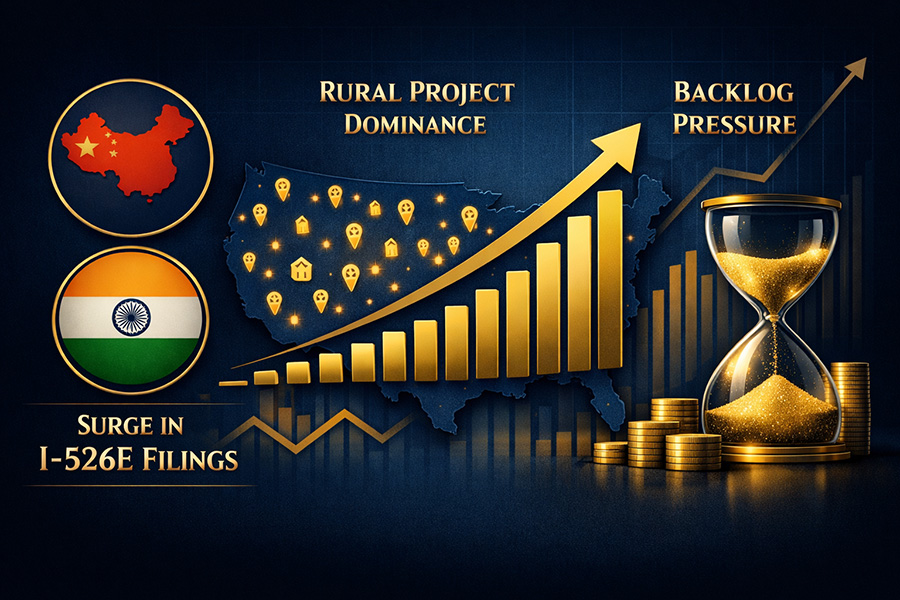
New I-526E filings are climbing, the pending inventory is growing faster than USCIS decides cases, and most of the new volume is pointed at the rural set-aside. That combination has one practical consequence. The categories that look fast today are fast mainly because few people have filed in them yet, and that is changing month by month. The engine behind the surge is the grandfathering deadline of 30 September 2026, and anyone still choosing a project should treat the deadline, not the marketing deck, as the fixed point in their plan.
What the published I-526E data actually contains
USCIS releases form level performance data on a quarterly basis through its immigration and citizenship data reports page. For Form I-526E, the Immigrant Petition by Regional Center Investor, each release shows receipts, approvals, denials and the number of cases still pending at the end of the quarter. Those four numbers are the whole story, and the one that matters most is the last one.
Receipts have been rising since the program restarted under the EB-5 Reform and Integrity Act of 2022. Approvals have risen too, but not at the same pace. When receipts outrun completions quarter after quarter the pending inventory grows, and the pending inventory is what determines how long a petition filed today will sit before an officer opens it. Denial numbers stay low, but that figure is easy to misread. Most weak petitions get a request for evidence first, so a low denial rate reflects a program where problems are usually fixable rather than a program where nothing is questioned. We look at that distinction closely in our page on EB-5 approval rates for I-526E and I-829.
One caveat before you build a timeline on any of it. The data lags by months, and the processing time USCIS publishes is a backward looking median of cases already decided, not a forecast for a case you file tomorrow.
Why filings are surging: the 30 September 2026 deadline
The EB-5 Reform and Integrity Act of 2022, Public Law 117-103 authorized the regional center program through 30 September 2027 and added a grandfathering clause. A petition properly filed on or before 30 September 2026 continues to be adjudicated even if the regional center program is not reauthorized afterwards. That is a genuinely valuable protection, and it explains the shape of the filing curve.
It is also narrower than it sounds. Grandfathering protects the processing of your petition. It does not protect the project. If a regional center loses its designation, or the borrower defaults, or the jobs are never created, grandfathering does nothing for you. The clause buys procedural continuity, not investment safety. Our overview of the EB-5 Reform and Integrity Act of 2022 sets out exactly what the statute does and does not cover.
There is a second date worth writing down. The minimum investment stays at $800,000 in a targeted employment area and $1,050,000 elsewhere until the first inflation adjustment on 1 January 2027. Two deadlines a few months apart, one on eligibility and one on price, are why the filing queue is behaving the way it is.
Rural filings are crowding the fast lane
The reserved categories split as 20 percent rural, 10 percent high unemployment and 2 percent infrastructure. Rural is the largest of the three, and the statute directs USCIS to give rural petitions priority processing. Investors and issuers both did the obvious arithmetic, and rural now absorbs the clear majority of new regional center filings.
Priority processing is real, but it is a queue position, not a guarantee of speed. Priority inside a queue that is growing quickly still means waiting. And a rural location is a fact about geography, not a verdict on the deal. Rural projects can have thinner local labor markets, longer lease-up periods and fewer refinancing options than a comparable urban project. The set-aside is a visa allocation mechanism. It says nothing about whether the developer can repay you. We break the trade-off down in rural versus metro EB-5 projects.
India and China face the same wall at different speeds
The per country limit applies inside each reserved category, not only to the unreserved pool. That single rule is the key to reading backlog risk correctly. If Indian or Chinese demand for rural visas exceeds roughly 7 percent of the rural allocation in a year, the Department of State applies a cut-off date to those countries in the rural category while the rest of the world stays current. Nothing about a set-aside makes it immune.
China has the longer accumulated queue and the deeper history in the program, described in our page on China and EB-5. India came later but files at high volume, and Indian investors have been notably willing to sue over processing delays. Our page on EB-5 for Indian investors covers how to lock a priority date early and what that actually protects.
For an investor born in either country the honest reading is this. A set-aside category buys you a shorter queue than the unreserved one, and it may buy you concurrent filing today. It does not buy a permanent exemption from retrogression. The relief lasts as long as your compatriots have not filled the category, and filings are the thing that is rising.
What a growing queue costs you in money, not just time
Waiting is not free. Your capital must remain invested and at risk for the statutory sustainment period, and if the project repays early while your petition is still pending, the fund has to put your money back to work somewhere else. That is redeployment, and it is the most underestimated risk in a long queue. The replacement investment may be safer, riskier or simply slower to return capital, and you usually have very little say in the choice. See EB-5 redeployment for how the clauses in a typical partnership agreement work.
The queue does not end at approval either. After the immigrant visa or Form I-485 adjustment of status you receive a two year conditional green card, and then you file Form I-829 to remove conditions. That stage has its own backlog, and many investors live on extension notices for years. Our page on I-829 delays explains what that feels like in practice.
How to read the numbers yourself
Three sources are worth checking directly rather than through a promoter's summary. The USCIS data page for quarterly form volumes. The monthly Visa Bulletin from the Department of State for cut-off dates. And Volume 6, Part G of the USCIS Policy Manual, the adjudication guidance officers actually apply to your file. If a sponsor quotes a processing time far better than the published median, ask which cases they are counting.
What to do with this before you wire the money
Your priority date is set by the date your I-526E is properly filed, so filing sooner is worth more than filing perfectly optimised. That said, a rushed source of funds file is the most common cause of a request for evidence, and an RFE costs more time than the weeks you saved. The correct order is to get the funds documentation defensible first, then file as early as the documentation allows.
Do not choose a project because it carries a set-aside label. Ask about the developer's own equity, the senior lender, the job creation model, the exit assumptions, and what happened to previous investors at the I-829 stage. If a timeline in a pitch deck sounds better than anything in the government data, treat that as information about the sponsor rather than about the market. Our page on I-526 processing times sets realistic expectations, and premium processing for EB-5 explains why paying for speed does not do what most investors assume it does.
Related reading
Sources
This page is written from primary sources published by the United States government. Last updated August 3, 2026. It is general information about how the EB-5 programme works, not legal advice about your case.
- USCIS immigration and citizenship data
- Form I-526E, petition by a regional center investor
- Public Law 117-103, the EB-5 Reform and Integrity Act of 2022
- Form I-485, adjustment of status
- USCIS Policy Manual, Volume 6 Part G on EB-5
Topics on this page: EB-5 Immigrant Investor Program, Targeted Employment Area, EB-5 Regional Center, EB-5 Reform and Integrity Act of 2022.