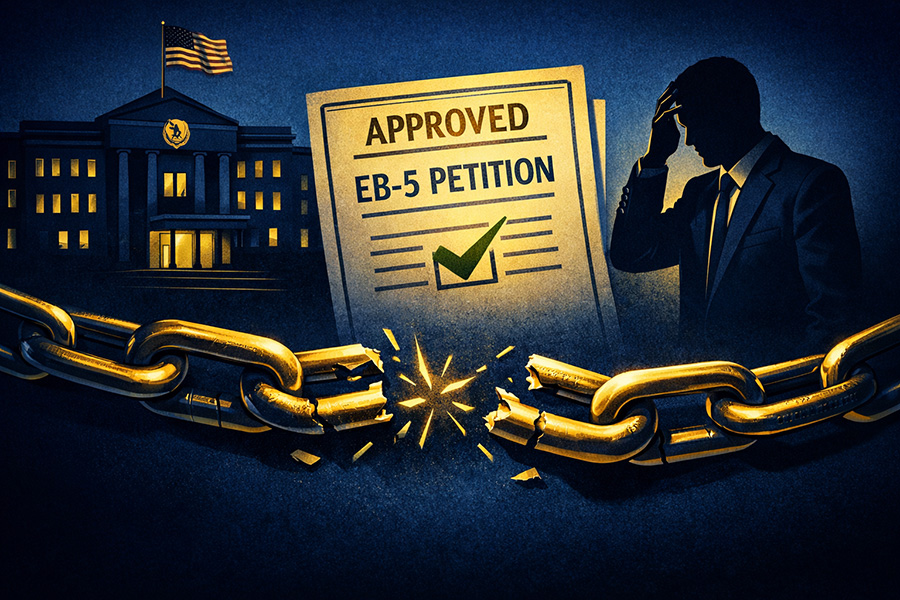
An approved I-526E petition is not a green card. It is permission to apply for one, and the stage that follows is where a real share of EB-5 cases stall for months or collapse outright. If you live outside the United States, your file leaves USCIS, moves to the National Visa Center, and eventually lands with a consular officer who had nothing to do with adjudicating your petition. That officer can reopen your source of funds, question your spouse, and refuse the visa under section 221(g) with almost no route of appeal. Petition approval is closer to halftime than to the final whistle.
What Happens Between I-526E Approval and the Interview
Most of the damage in this phase happens in the paperwork, not in the interview room. After approval, USCIS forwards the petition to the National Visa Center. The NVC creates a case, collects the immigrant visa fees, and then waits for two things: a DS-260 immigrant visa application for every family member, and a civil document package. That package means birth certificates, marriage and divorce certificates, police certificates from every country where an applicant lived long enough to trigger the requirement, court and military records where they exist, and certified translations of anything not in English.
Only once the NVC marks the case documentarily qualified does it schedule an interview at the post you selected. Before that appointment, every applicant completes a medical exam with a panel physician the embassy has approved. USCIS lays out the general route on its consular processing overview for green card applicants, but the details that decide your case sit in the instructions of the individual embassy, and those vary far more than investors expect.
The Five Places Approved EB-5 Cases Actually Break
- Document mismatches. A surname transliterated one way on a passport and another on a birth certificate. A date of birth that differs between the I-526E and the DS-260. A police certificate from the wrong jurisdiction. These are boring problems and they cause most of the lost time. Anything that contradicts the petition invites a fresh look at the whole file.
- 221(g) refusals. The officer refuses the visa under section 221(g) of the Immigration and Nationality Act and asks for more. In EB-5 the request usually concerns source and path of funds: where the money originated, how it crossed borders, who controlled the intermediate accounts, whether a gift or a loan was documented properly. The case sits refused while you assemble the answer.
- Security screening. Applicants with military service, sensitive scientific or engineering backgrounds, government or party roles, or nationality subject to heightened vetting can wait a long time for interagency checks to clear. Nothing moves the case forward during that period, and follow up does not speed it up.
- Post specific surprises. Some consulates want originals where you were told copies would do. Some insist on translations produced locally. Some have thin immigrant visa capacity. Suspension of services at a post, for security or political reasons, can strand a documentarily qualified case indefinitely.
- Interview answers that contradict the file. An investor who cannot explain in plain language where the $800,000 came from, or a spouse who describes the project differently from the offering documents, creates doubt that the paperwork then has to work hard to undo.
What a 221(g) Hold Really Means
A 221(g) is not a denial and it is not an approval. It is a refusal that stays open pending further action, and that status has three unpleasant consequences. There is no statutory clock, so administrative processing can run for weeks or for many months and the post is not obliged to explain itself. There is effectively no appeal, because there is no final decision to appeal and consular decisions receive very little judicial review. And a case that sits long enough will outlive the validity of the medical exam and the police certificates, which then have to be redone at your expense.
The productive response is unglamorous. Answer exactly what was asked, in the format asked, in one complete submission rather than in installments. Attach a short plain English summary that walks an officer who is not a securities lawyer through the money in a straight line, from the original source to the escrow account. Keep a dated record of every submission. If the case ages badly, a formal status request through the post or a congressional inquiry usually accomplishes more than another round of emails. Investors who have been through this describe it honestly in our account of one EB-5 case that went from setback to approval.
Consular Processing Versus Adjustment of Status
If you are already inside the United States in a valid nonimmigrant status, you may be able to skip the consulate entirely by filing Form I-485 to adjust status. Since the EB-5 Reform and Integrity Act of 2022, that application can be filed at the same time as the I-526E when a visa number is available in your category. USCIS explains the framework on its adjustment of status page, and the Form I-485 instructions and current fees are published separately.
The advantages are concrete. You stay in the country. You can request an employment authorization document and advance parole alongside the I-485, so a spouse can work and the family can travel while the case is pending. There is no NVC document package, no panel physician abroad, and in most EB-5 cases no interview at all. The trade offs are equally concrete. Adjustment requires you to hold and maintain lawful status, and a lapse can be fatal to the application. Travel without advance parole abandons it. And an approved I-485 produces exactly the same outcome as a consular visa: two year conditional residence and an I-829 obligation at the end of it.
Who Should Seriously Weigh Adjustment of Status
- Applicants served by a strained post. If your consulate has limited immigrant visa capacity, heavy security screening or a history of suspended operations, adjusting inside the United States removes an entire category of risk in one move.
- Families with a child approaching twenty one. Age out exposure is a timing problem, and consular delay is pure timing risk. The arithmetic is set out in our guide to the Child Status Protection Act in EB-5 cases, and it is worth doing that calculation before you choose a route rather than after.
- Students and professionals already here. An F-1 or H-1B holder who can file concurrently gets work and travel authorization years before the green card and avoids an overseas interview altogether.
- Investors with a complicated funds trail. A USCIS officer who approved the petition has already seen the evidence. A consular officer starts from zero, and complexity that survived one review can attract a second one.
What does not work is treating adjustment as an escape hatch you reach for once the consulate turns difficult. You cannot enter on a visitor visa intending to file, and you cannot manufacture a status you do not hold. If adjustment is the plan, it has to be the plan before the petition is approved, which is one reason the route question belongs in the same conversation as assembling the I-526 document package.
Preparing So That the Interview Is Boring
The goal is an interview with no surprises in it. Build a single consolidated funds narrative of two or three pages, in plain language, cross referenced to the exhibits, and make sure the investor can tell that story out loud without notes. Reconcile every name, date and place across the passport, the civil documents, the DS-260 and the petition, and prepare a written explanation for any discrepancy you cannot fix. Confirm the panel physician requirements early, because the EB-5 medical exam and vaccination rules catch families out more often than any legal issue does. Bring originals of everything. Prepare the spouse as carefully as the investor. And know which agency does what, because the division of labor between USCIS, the Department of State and the SEC is not intuitive; our page on the agencies and forms that run the EB-5 process maps it out.
After the Visa Is Issued the Clock Starts
An issued immigrant visa carries a limited validity period, generally tied to the medical exam, and you must enter the United States within it. First entry activates conditional residence, which lasts two years and ends with the I-829 petition to remove conditions. USCIS publishes the standards that govern that status in the EB-5 chapter of the USCIS Policy Manual. Plan the first entry deliberately, because the date you land drives the two year window, the tax residency question and the physical presence expectations that follow it.
Related reading
Sources
This page is written from primary sources published by the United States government. Last updated August 3, 2026. It is general information about how the EB-5 programme works, not legal advice about your case.
- USCIS on consular processing
- USCIS on adjustment of status
- Form I-485, adjustment of status
- USCIS Policy Manual, Volume 6 Part G on EB-5
Topics on this page: EB-5 Immigrant Investor Program, EB-5 Reform and Integrity Act of 2022, Form I-526E, Form I-829.