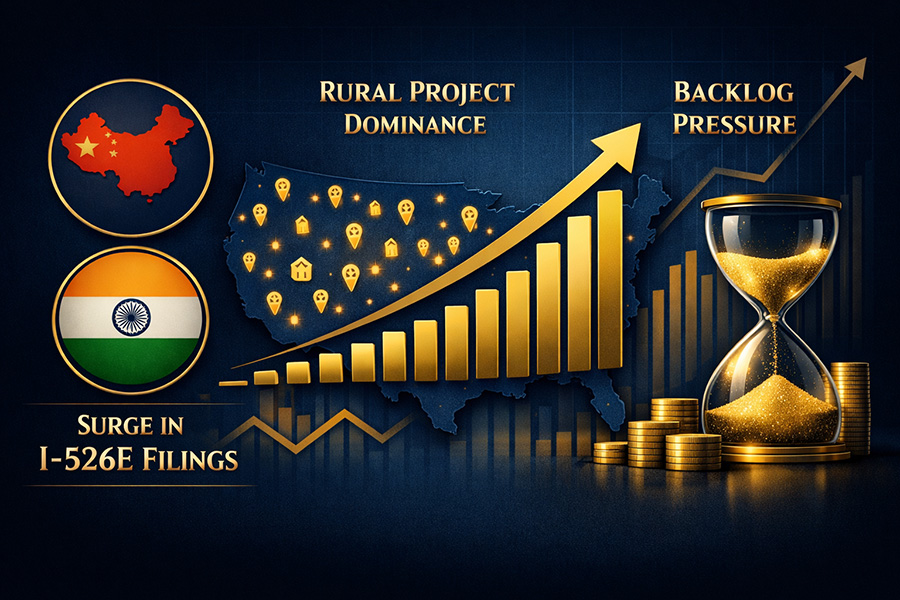

Retrogression in EB-5 means the State Department pushes a category's cut-off date backward, and it can happen in a single monthly bulletin because the demand that triggers it stays invisible until it lands. Around 10,000 immigrant visas a year are available to EB-5, being 7.1 percent of the worldwide employment based limit, and every spouse and child consumes one of them. A family of four uses four numbers. Once documentarily qualified demand exceeds what is left of the annual supply, the cut-off has to move. Movement comes as a step rather than a slope.
Retrogression in one paragraph of arithmetic
Three reservations sit on top of the annual total under the EB-5 Reform and Integrity Act of 2022. Rural projects take 20 percent, high unemployment areas take 10 percent, and infrastructure takes 2 percent. The remaining 68 percent is the unreserved pool, where most historical demand has always sat.
Layered across all of it is the per country ceiling of 7 percent, which lives in 8 U.S.C. 1152 rather than in the EB-5 section itself. No single country takes more than that share of a category in a year unless numbers would otherwise go unused.
Reserved numbers that nobody uses in a fiscal year carry forward inside the same reserved category for the following year, and if they remain unused after that they drop into the unreserved pool. That carry forward is a large part of why the rural and high unemployment queues have stayed current longer than filing volumes alone would suggest. The mechanics are unpacked further in EB-5 Visa Allocation: Categories, Set-Asides and Unused Visa Rollover.
Why a category flips from current to backlogged in a single month
Filing and visa use are separated by a long gap. A petition lodged today consumes no visa number until the investor is documentarily qualified at the National Visa Center or holds an approved petition with a pending Form I-485 ready for adjudication, and that gap runs well over a year in most cases. The Visa Office cannot count demand it cannot yet see. So the charts lag reality by design, and by the time a bulletin reflects a wave of petitions filed two years earlier, the investors behind those petitions have long since wired their money and cannot unwind the decision.
Pressure accumulates quietly, then arrives all at once.
Fiscal year mechanics add a second layer. Numbers reset every 1 October. Late in a fiscal year the office may impose or hold back a cut-off purely to stay inside the annual limit, then advance the date again in October when a fresh allocation opens. A category being current in August therefore tells you very little about the following spring. Anybody reading the charts should start with EB-5 Visa Bulletin Explained: How to Read Priority Dates and Cut-Offs.
Pressure points in the reserved and unreserved pools
Unreserved EB-5 for China and India carries the heaviest historical load and shows strain earliest. Reserved categories have absorbed post-RIA demand so far, helped by the carry forward rule and by the plain fact that all three reservations started empty in 2022. Neither advantage is permanent.
Look at the size of the rural reservation before assuming it is roomy. Twenty percent of roughly 10,000 numbers is about 2,000 a year, derivatives included. If that queue ever became oversubscribed, the 7 percent ceiling would leave a single country somewhere near 140 numbers, which at three or four per family is a few dozen households. Investors drawn to that queue by processing priority should read Rural EB-5 Timeline: How the 20% Set-Aside and Priority Processing Work alongside EB-5 for Indian Investors: Backlog, Rural Set-Asides, Concurrent Filing.
What filing early actually locks in
Your place in the line. Nothing else.
If a cut-off retrogresses past your priority date after you file, you wait for it to advance again. Later filers never overtake you. That is the entire value of moving early, and on a backlogged chargeability it is worth a great deal. Filing early buys nothing else people hope for. It will not accelerate adjudication. A weak project stays weak, and the capital stays exposed.
A pending Form I-485 keeps its own protections while it sits. Employment authorization and advance parole can be renewed while the underlying application waits, so retrogression after a concurrent filing usually costs time rather than status. Who actually qualifies for that filing combination is set out in Concurrent Filing of I-526E and I-485: Who Can File Both Together.
Children are the sharp edge of any backlog. The Child Status Protection Act subtracts the time USCIS spent adjudicating the petition from a child's age. It does not subtract time spent waiting for a visa number, and for a backlogged country that waiting is where nearly the entire delay sits. A seventeen year old at filing can still age out.
Check these signals every month
Read both charts in the monthly Visa Bulletin published by the State Department, Final Action Dates and Dates for Filing, and note that USCIS announces separately which chart adjustment applicants may use in a given month. Large forward jumps carry information too. A big advance often means the office is trying to use numbers before they expire, which says something about the current year and very little about the next one.
Annual usage data beats monthly speculation. The State Department immigrant visa statistics show how many EB-5 numbers each country actually consumed, which is the only hard measure of demand available to the public. For how petitions are adjudicated once you are in the queue, the governing text is Volume 6, Part G of the USCIS Policy Manual.
Do not let a deadline replace diligence
Filing early to secure a priority date is a defensible reason to move quickly. Buying into a weak offering because a bulletin looked tight is something else, and the sales pressure built around retrogression deserves naming for what it is. A poor project with an early priority date still loses the $800,000. Both risks are real at once. Read EB-5 Capital At Risk: What It Means for Your $800,000 Investment before you accept any deadline as a reason to shorten diligence.
Two program dates run alongside the visa queue and matter independently of it. Regional Center authorization extends to 30 September 2027. Petitions filed on or before 30 September 2026 are protected by 8 U.S.C. 1153(b)(5)(S), titled Protection from expired legislation, and continue to be processed even if the program lapses. The first inflation adjustment on 1 January 2027 lifts both the $800,000 and the $1,050,000 thresholds, which is a cost deadline rather than a queue deadline.
Confusing those three clocks is the most common planning error we see.
Related reading
Sources
This page is written from primary sources published by the United States government. Last updated August 5, 2026. It is general information about how the EB-5 programme works, not legal advice about your case.
- State Department, the Visa Bulletin
- State Department visa statistics
- USCIS Policy Manual, Volume 6 Part G on EB-5
Topics on this page: EB-5 Immigrant Investor Program, EB-5 Regional Center, EB-5 Reform and Integrity Act of 2022, Form I-526E.