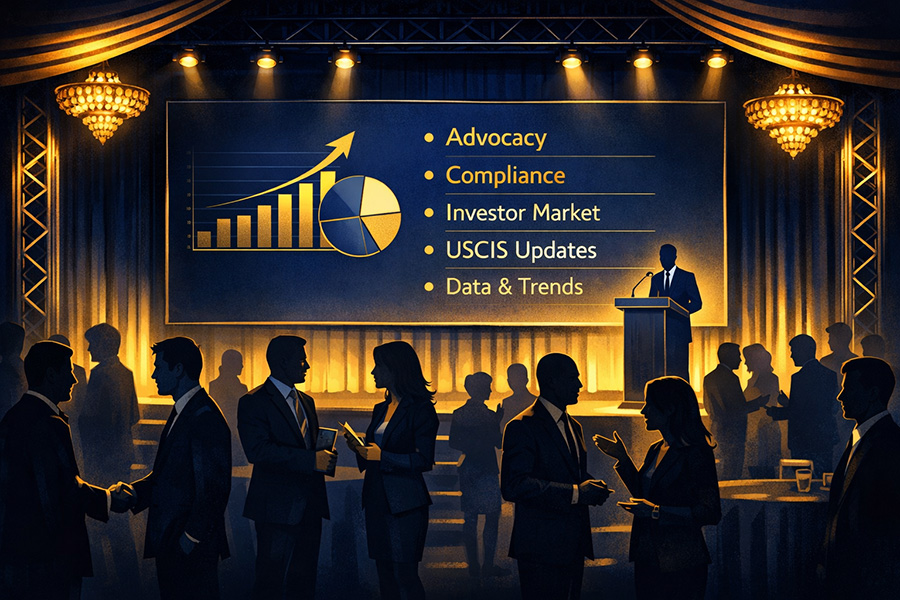
The IIUSA Industry Forum is the annual policy conference run by Invest In the USA, the EB-5 trade association, and it is where the industry argues in public about reauthorization, compliance and investor demand. The host city changes from year to year, and the 2026 edition ran in Washington DC over three days in the spring, so check dates and venue on IIUSA's own site rather than assuming last year's arrangements still hold. The agenda has settled into five recurring threads: advocacy and reauthorization, compliance with the EB-5 Reform and Integrity Act of 2022, filing and visa data, the wider immigration policy backdrop, and investor demand by market. The audience is regional centers, developers, fund administrators and attorneys, which shapes everything said from the stage.
Who the forum is actually for
This is an industry event, not an investor event. The people in the room are raising capital, administering funds or advising the parties who do. That does not make the content useless to an investor, but it does mean the framing is commercial. A panel is not diligence, a sponsor's presence on a stage is not a credential, and a slide showing strong demand is not a reason to write a check for $800,000.
For most individual investors the sensible approach is to read what comes out of the forum rather than attend it. The data presentations, the reauthorization commentary and the compliance discussions eventually surface in industry write ups and in the trade press, and they are more useful to you as evidence than as atmosphere.
The five threads that dominate the agenda
Advocacy and reauthorization
The single date driving every advocacy session is 30 September 2027, when the current authorization of the regional center program ends. The second is 30 September 2026, the grandfathering cut off: petitions properly filed by then continue to be processed even if the program lapses. Expect discussion of when Congress might act, what a reauthorization package could contain and how the 2021 lapse should inform planning. Nobody on any panel knows the answer. Treat confident predictions accordingly, and read Sunset 2027: What If Congress Fails to Extend the RC Program for the mechanics of what a lapse would and would not affect.
Compliance under the Reform and Integrity Act
This is usually the most practically useful part of the program. Panels cover annual reporting, fund administration, separate accounts, the integrity fund, site visits and audit readiness. The centerpiece is the annual statement each regional center must file, described on the USCIS page for Form I-956G, the regional center annual statement. An investor who understands that filing has a genuine tool: you can ask a sponsor whether their annual statements have been filed on time and whether they have been through a USCIS audit or site visit, then compare the answer with what the compliance panels describe as normal.
The data session
The data presentation covers filing volumes, visa issuance, country mix and how the reserved categories are filling up. This matters more than any other session for a prospective investor, because it is the closest thing to an honest read on how long the rural and high unemployment lanes will stay fast. The numbers themselves originate with USCIS and the State Department rather than with IIUSA, so any chart on the screen can be traced back. For the rules those figures sit inside, the primary text is Volume 6, Part G of the USCIS Policy Manual on immigrant investors, and for the queue itself it is the monthly bulletin explained in The EB-5 Visa Bulletin: How to Interpret Priority Dates.
The wider immigration policy backdrop
EB-5 does not exist in isolation. Changes to employment visa categories, to screening requirements or to consular capacity all feed demand into the investor route. Sessions on this theme are speculative by nature. If you want to follow the rulemaking itself rather than the commentary about it, the running list of proposed and final rules is available through the Federal Register search results for EB-5.
Investor markets and regional center operations
Panels here cover where demand is coming from, how agents and marketing work in each region, and how to run a regional center in the post 2022 environment. For investors this is the clearest window into how you are seen from the other side of the table, including how you were sourced and who is paid when you subscribe. Commission disclosure rules introduced by the 2022 reforms make that question fair to ask of anyone advising you.
What to take from the forum without attending
- The reauthorization temperature. Not a prediction, but whether the industry is planning around a lapse or around continuity.
- Which set aside category is filling. This changes your realistic timeline more than any project feature.
- What regulators are focused on. Audit and site visit themes tell you what a sponsor should already have in order.
- Where demand is shifting. Rising demand from a market shortens the queue advantage for everyone in it.
If you are going, prepare like a professional
Write your questions before you arrive and tie each to a decision you actually face: redeployment, fee compliance, sustainment, reporting, or the timing of your own filing. Book meetings in advance, because the corridors are where the useful conversations happen and the calendars of the people worth meeting fill early. If you are new to the mechanics, IIUSA has historically run introductory sessions alongside the main program, which are a better use of a first visit than sitting through advanced policy panels.
Bring skepticism to the exhibition floor. Sponsors attend to raise capital, and a polished booth tells you about a marketing budget rather than about job creation. Anything that interests you should be run through the same process you would apply to any other offering, starting with the questions in Questions to Ask a Regional Center or Developer Before Investing.
What a conference cannot tell you
It cannot tell you whether a specific project will create your ten jobs, whether your capital will be returned, or when your priority date will become current. Those answers live in offering documents, economic reports, audited accounts and the visa bulletin, not on a stage. The forum is a useful barometer of where the industry thinks it is going, and the statutory text it argues about is public: Public Law 117-103, containing the EB-5 Reform and Integrity Act of 2022 is worth an hour of your time before you listen to anyone interpret it for you.
Related reading
Sources
This page is written from primary sources published by the United States government. Last updated August 5, 2026. It is general information about how the EB-5 programme works, not legal advice about your case.
- Form I-956G, the regional center annual statement
- USCIS Policy Manual, Volume 6 Part G on EB-5
- Federal Register
- Public Law 117-103, the EB-5 Reform and Integrity Act of 2022
Topics on this page: EB-5 Immigrant Investor Program, EB-5 Regional Center, EB-5 Reform and Integrity Act of 2022, EB-5 job creation requirement.